
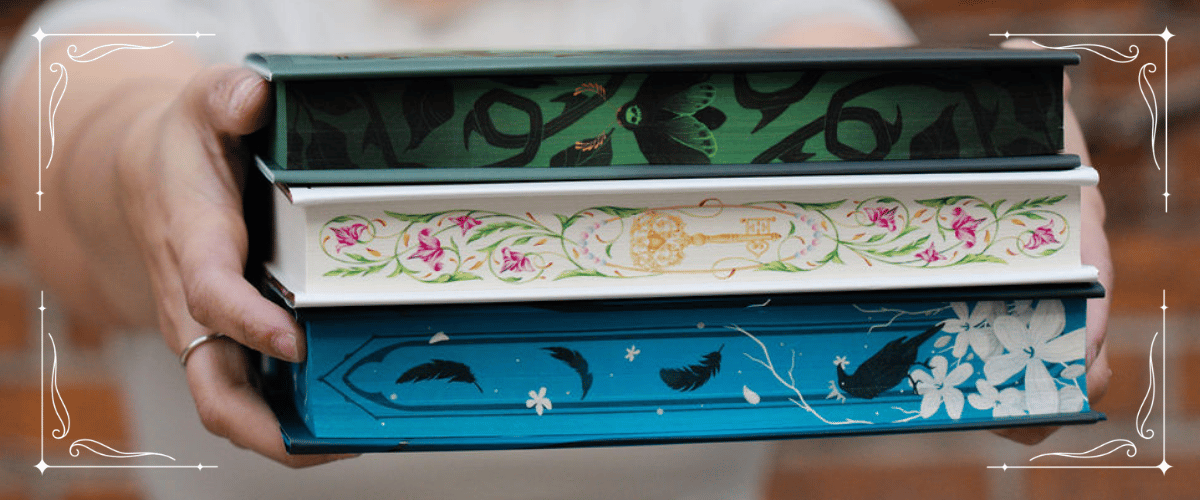
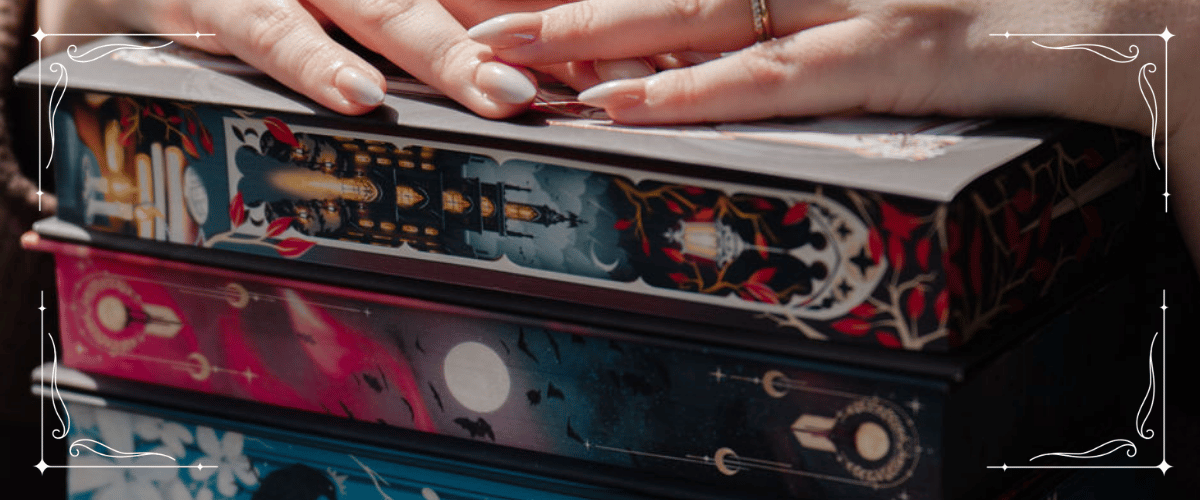


When you think of sprayed edges, you probably think of modern special editions of books. Today, book lovers adore collecting beautifully ornate redesigns of their favourite stories, gilded with foiling and adorned with gorgeous artwork on not just the cover, but on the endpapers and edges, too. But actually, the magic of decorative edges is far older than many realise… they have been capturing the attention of readers and enchanting them for centuries! ✨
Long before you were admiring the likes of character art, dragons, florals, and celestial designs on your exclusive FairyLoot editions, the world had seen many iterations of the trend. Keep reading as we turn the pages of sprayed edge history, discussing the patterns and techniques we’ve seen change throughout time. 🏛️
10th Century
Did you know that the story of decorative edges begins back in the 10th century, when books in medieval libraries were often shelved with their spines turned inward and unbound edges outward? This was to make identification easy, as book titles were usually painted directly onto the edges, instead of being placed on the spines like we’re used to seeing today. So edge designs began as a practicality, rather than for the decorative purposes we know and love now.
16th Century
It is believed that titles gradually began to appear on spines in the 1500s, making books more similar in appearance to what we recognise today. But even then, the edges still remained important, often to indicate ownership or to display heraldic symbols and other identifying details. But as humans, we’ve always been drawn to beautiful things, and so as the Middle Ages continued to progress, scribes and bookbinders were increasingly adding embellishments to enhance treasured manuscripts. Among the most striking was gold leaf, which was often used to create gilded edges for religious works, symbolising the sanctity of their contents. Not only was this an aesthetic decision, gold leaf served a practical purpose. It helped to protect delicate parchment from dust and moisture, and prevent the pages from browning.
17th Century
The 1600s marked a huge turning point in the history of decorative edges. No longer primarily used for displaying information, the edges of books evolved into a canvas for artistry and imagination, often depicting mythological creatures, pastoral scenes, and pretty patterns. Famously one of the pioneers of the craft, a Venetian painter named Cesare Vecellio created stunning scenes on the very outer edge of books, so the full painting was only visible if the tome was closed. Whereas Samuel Mearne, a royal bookbinder in England, developed a different form of edge painting. By painting slightly inside the pages, by optical illusion, a little piece of magic would be revealed in the form of artwork, only visible if the pages were fanned out.
19th Century
Edge designs became immensely popular in the 19th century, encouraging bookbinders and artists to push the boundaries of their craft with even more spectacular designs. Edge designs started to extend, with cohesive illustrations covering not just the unbound side, but also wrapping around the top and bottom edges. You could also find volumes which combined outer-edge designs and hidden fore-edge artwork, delighting readers with multiple layers of discovery. Beyond their mesmerising swirls, marbled edging was also fashionable during the Victorian era as an act of security. Because of their unique patterns, it could be easily seen if they’d been tampered with or if pages had been removed.
20th Century
With the 20th century came mass-market paperbacks, causing the intricate artistry of edge design to become increasingly rare. As printing methods evolved and books became more widely accessible, ornate details quietly slipped into the background, waiting to one day be re-discovered by a new generation of readers!
21st Century
And here we are in the present day, in a century that has seen a wonderful resurgence in sprayed edge designs. Momentarily becoming a forgotten craft, they’re back and better than ever, now adorning many special editions and turning stories into desired keepsakes. With the rise of BookTube and BookTok, these delightful details are often and affectionately referred to as “spredges”. Reading and owning gorgeous, exclusive editions feels ever so special, as they truly bring the storytelling to life. 🤩
Which FairyLoot edition features your favourite sprayed edge? We’d love to know! 💜
Blog Post Copied to Clipboard
Most Recent Stories

Follow Us
Most Recent Stories
Conversation
0 Comments