

Get the inside scoop on ‘Coldwire’!
Chloe Gong is the author of our December YA ‘Neon Lies’ featured book: Coldwire. Read on to get the inside scoop from inspiration to favourite scenes and more!
Coldwire is your first dystopian novel. Could you tell us a little bit about what inspired you to write a story of this genre?
I jump across genres willy nilly! I have actually always wanted to write a dystopian story, I just happened to start in a very different arena. For a while, I was in the YA historical fantasy space and was writing about 1920s and 30s Shanghai. Then, I made the jump into adult fantasy where I pressed into this realm of the 90s with dark alleyways and low tech. So, I was starting to edge closer and closer to this cyberpunk, dystopian feeling, but I hadn’t quite gotten there yet because whilst I had the desire, I just didn’t know what the story was yet. And then as publishing moves so quick, trends move in and out, science fiction and dystopian became kind of dead. Which was fair because we had a lot, but I was sat there like I have a really good idea and I want to do this soon! So it was more a case of there were some stories that needed to be told first, and Coldwire had to cook. And then at a time where I finally felt ready to approach it, The Hunger Games came back! Ballad was announced at the time I was developing it and I was like, oh my god, this is a sign! Suzanne Collins is bringing it back, and I can join!
What inspired you to write a cold war between Atahua and Medaluo?
So I was an International Relations and English double major in college, and I have always been fascinated by the idea that we don’t really operate just by our government and what they’re doing, as we are in a hugely globalised world. And then I was looking at speculative and dystopian fiction and I was very interested in how most books that examine these ideas are about one government versus their people. If we think about any narrative where there’s a rebellion or an uprising against a corporation or the government, it tends to be focused around one country. But if you look at our own world, we don’t really see that in the way that our history started moving forward. Everything that a major country does is in the context of the countries around it, whether that’s enemy nations or ally nations. So when I was thinking about Coldwire, I knew from the get-go that this cold war between two major, ideologically opposed countries would be my backdrop. That’s what would make it different to other works of speculative fiction that I have read because I was more interested in how a country would react in the context of a possible enemy across a cold war zone, as opposed to a country that is building in power off its own volition. That, to me, feels like something us as readers understand better, and what is dystopian fiction if it’s not some sort of mirror to us?
StrangeLoom was an extremely fascinating concept. We’d love to know more about how you went about creating it and what challenges you faced in bringing it to life.
It freaked me out creating it, because the more research I did, the more I realised how feasible it would be in our world. I tried to keep the science in Coldwire as scientific as possible. Of course, it’s still a work of fiction, but I wanted to get it as close as possible to how I imagine this developing. And all of this is real, to an extent. In our world, there’s existing digital twin technology, there’s satellites that essentially scan the world and can create a very accurate model. And now, with AI technology, world modelling is getting really good. It’s a development that’s happening this year, which is crazy, because Coldwire was written years ago when it was all truly hypothetical to us. It’s such an interesting space because, of course, technology will come with elements that feel enticing. Back when I was stuck in my tiny apartment in COVID, I was thinking about how much fun it would be if, instead of Zoom, you could walk around virtual reality and things wouldn’t have to change. It was then that StrangeLoom started to feel like a possible concept that could make life easier. But then, the next thought is about what is being given up in exchange for that. If you do live in a virtual reality, are they going to know everything about you? Are they going to hear everything you say? Will you ever have true privacy? I really wanted to look at those ideas on a larger scale.
What was the most challenging and most rewarding part about writing Coldwire?
I think it was the structure, because Coldwire is split between two point of views between Eirale and Lia, who are characters that don’t meet for a very long time and exist in separate planes of reality. And I could not get the hang of it for the longest time! I still remember when I handed my first draft to my editor, and she was like, these two people sound the same! I hadn’t written in first person for years, so everything I wrote sounded like it was one voice. So it took a lot of drafts before I started to understand the points that these characters were starting at. I really needed to root myself into the idea that Eirale is a character who is not very emotional, she’ll observe things as they are and she will give that to the audience point blank. Whereas Lia is very dramatic. And the moment I realised that was beautiful!
When did the first idea for Coldwire spark, and how has it changed throughout the entire editing and publishing process?
The ending was the first thing that came to me, that tends to be the way that I find my way around a book. Having that final image in my head really helps me to conceptualise the world getting to that point. And that final outcome that I had, that never changed throughout the writing process. But during the writing process and editing, there were times I thought the plot would have to go this way or that to get to where I wanted things to end, but my editor would be like, what about this? So there were lots of big picture changes that I never envisioned when I first started.
We love Lia and Kieren. Their relationship was authentic, warm, and full of banter and a deep understanding of one another. How did you go about crafting their complex relationship while maintaining the integrity of their own individual character arcs?
Lia and Kieren came to me at an interesting point in my writing career. I was looking back at my characters and realised that I had been doing enemies to lovers for a very long time. Everyone seems to start off on the wrong foot, everyone is either ideologically opposed or they need to put their own goals ahead of the love interest and things like that. And that has always worked for the stories and the characters, but when I got to Coldwire, I wanted to do something a little different. It might feel a little more subtle, a little less explosive, but I wanted it to be more quiet with Lia and Kieren, without missing the tension. Readers jump in to them knowing each other for about four years. They know each other very well and have been competing with each other and learning how the other works for a long time, so I knew that meant missing out on what is usually the fun, getting to know each other part. But then, the fun of it became the fact they’re still mean to each other because they’re rivals, but you can’t spend four years competing with someone and not end up being kind of friends with them! So I wanted a dynamic that felt complicated, but in a way that felt natural and familiar. And I wanted to get across why this rivalry is so important to them and why they can’t just set it aside if they maybe like the other. But in any scenario, leaning into the angst will always get that dynamic going!
What’s something new you’ve learnt about yourself and your writing process during the creation of Coldwire that wasn’t present in your previous projects?
This is a little random, but I learned that I actually love writing text messages! I have never gotten to in my other books because the technology hasn’t been there. But the first time I got to write the word LOL was like, oh my god, beautiful! And the first time I got to choose emojis, that was also beautiful. When you think of being an author, you don’t think about writing stuff like that. But it made the characters come to life!
What are some writing rituals that you have that help you get into the writing zone?
Caffeine! Lots of caffeine. I tend to write at cafés as I don’t have a dedicated writing office, so I like to kickstart my days there. I feel like if I have a big cup of iced vanilla oat latte, I’m in the zone! That first sip locks me in. My days are a bit more messy past that, as I’m a bit too chaotic for rituals. I started writing when I was a student still, and so I would end up jamming in writing whenever I had any free time. And so I’ve always done it in a way that’s hard to define by a ritual, but once I graduated and I ended up doing this full-time, I tried to build more of a structure for myself.
Could you tell us a little about how you overcome writer’s block?
I find writer’s block is usually for one of two reasons. The first one is that you’ve gone wrong somewhere in the story. I always think, at what point in my writing did I start slowing down? And sometimes that writer’s block is just my brain telling me it thinks we took the wrong path somewhere, and it just doesn’t feel correct for the story. Sometimes I backtrack just a line if that’s all it takes, or sometimes I backtrack a whole paragraph or even a whole chapter, and that can get the juices flowing again. If none of that works, I figure it’s probably the second reason and that is that I’m too tired. I think there’s writer’s block when it comes to your book, and writer’s block when it comes from your mind. And a lot of times it’s actually mental, and there’s nothing you can do to stop it except recharge. Refill the well. Go outside. See your friends. Go for a walk. I think as writers, we really like to try to push ourselves as if it just takes willpower and then we’ll be able to do it. But it’s also an art! It’s a creative thing for a reason. And when your brain juices are sapped, no matter how much you push yourself, it’s going to feel hard.
What do you hope readers will take away from Coldwire?
First and foremost, I hope they take away a fun story! No matter how much I talk about the themes and my intentions and the academic inspiration behind anything, I still want them to have fun! At the end of the day, I feel like speculative fiction and any sort of novel series should feel fun. Past that, I also really hope that Coldwire serves as an interesting jumping off point for a lot of discussions that I think we are seeing more of recently. Especially from young people who may not otherwise have the resources to discuss these topics if they don’t feel like experts in it. These ideas, whether its AI technology or virtual reality or tyrannical governments, we are seeing covered in the news more now but I still feel like some people think that they don’t have the means to speak on it. But I think if you have fiction as an example, it gives you an entry way to read up on key terms or start that conversation with your friends and family. It doesn’t mean you need to be able to speak on it as an expert, but it can make you can develop your own understanding and opinion on it.
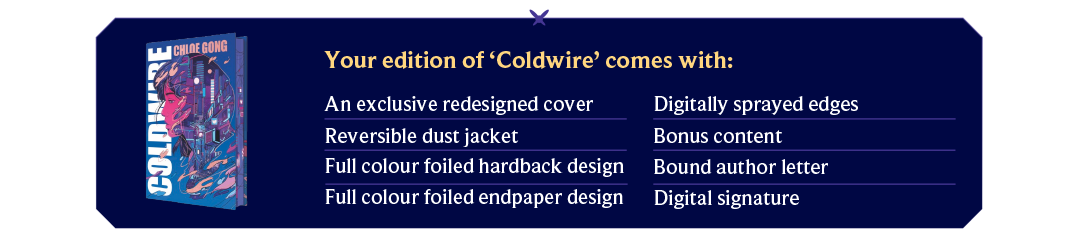
What’s your favourite thing about the FairyLoot edition of Coldwire?
Can I say everything?! It is just so beautiful. The foil is truly gorgeous, and I do think the cover is one of my favourites that I have ever seen. I am also a big fan of the endpapers, and the fact that they’re also foiled! And this is a small detail, but you know what I really love? The fact that the head and tails bands are bright pink! Everything captures the feeling of the book so well.
Author Recommends
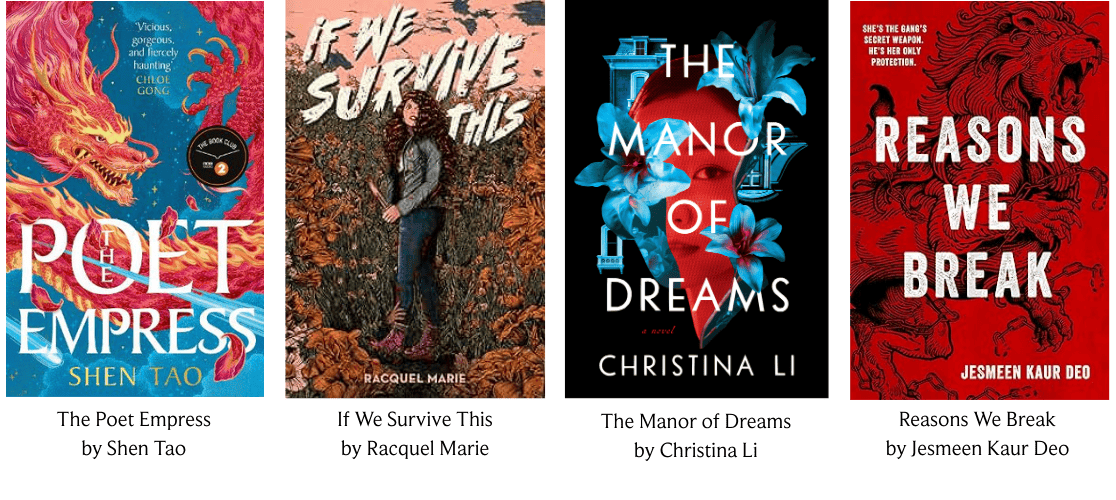
Have you ever wondered which books your favourite author thinks are an absolute must read? Well, wonder no more! Here are four books Chloe Gong thinks everyone needs on their TBR:
Blog Post Copied to Clipboard
Most Recent Stories
Follow Us
Most Recent Stories

Conversation
0 Comments