



Get the inside scoop on ‘Agnes Aubert’s Mystical Cat Shelter’!
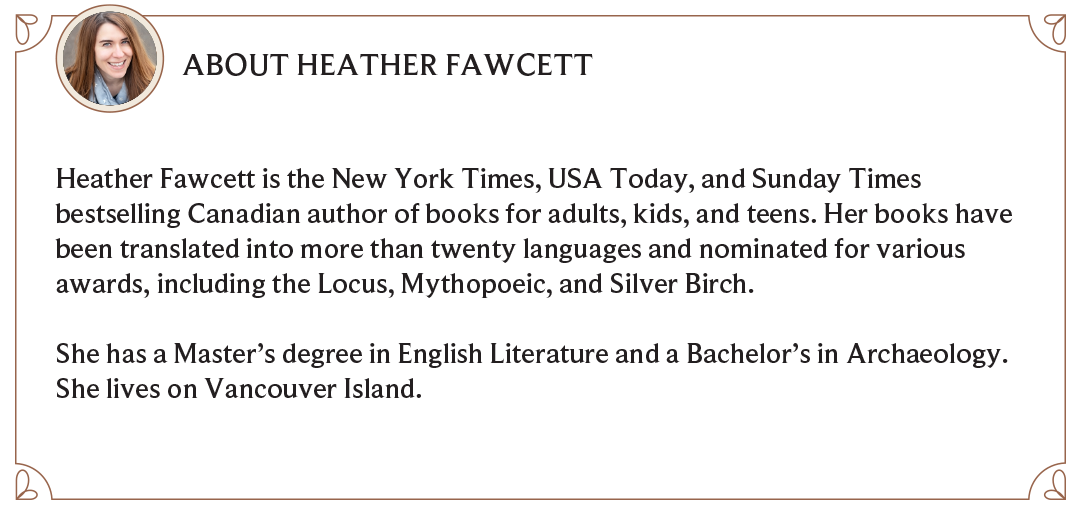
Heather Fawcett is the author of our Quarter 1 Cosy ‘Tails of Magic’ featured book: Agnes Aubert’s Mystical Cat Shelter. Read on to get the inside scoop from inspiration to favourite scenes and more!
What was the first idea behind Agnes Aubert’s Mystical Cat Shelter; the cats, the shelter, or Agnes herself?
I guess it was partly because I love cats, but I just wanted to write a book that was set in a cat shelter. The original seed of the idea predated Emily Wilde, actually, but it wasn’t until I came across an article about Montreal and the growth of the street cat population there, when the pieces started to come together in my brain. It was about this organisation that was trying to rescue street cats, as winter is a very dangerous season in that part of the world. It made me realise, ok, I want to write this story now!
What drew you to writing a story centred on magical cats and caretaking?
Some of my favourite books have prominent cat characters. Like, one of my favourites is Mogget in Sabriel by Garth Nix, who is just this wonderful but evil character, who would absolutely murder his humans if he could, and I love a cat character like that! Also Pantalaimon from His Dark Materials, the Cheshire Cat from Alice in Wonderland, there’s just so many side character cats that I’ve loved in books, and I just really wanted to write a book where cats were the story, where the plot revolves around them. I’ve also owned shelter cats my entire life — my current cat, Artemis, was adopted from a shelter. So, I know how much love shelter cats can give and how wonderful they are as pets, and I wanted to write a story that celebrated that!
What was your inspiration behind the main characters, Agnes and Havelock?
I think Agnes was largely inspired by not just one specific person, but a number of people I’ve known who are longterm volunteers, or work for a non-profit organisation in some capacity. I’ve observed that those people tend to combine this really intense compassion and this very hyper-organised type A personality, which I think is a really interesting pairing. And it makes sense, too, because a lot of charities operate with really thin margins and not a lot of room for manoeuvring, so you have to be really careful and really organised to make things work. So that’s where Agnes came from, just observing the kind of people who are running these charities and going from there. Havelock, he actually took me a little more time to figure out, and I went through a few iterations of his character. But basically, as Agnes represented order, I wanted someone else to represent chaos. Obviously, you put those two together, and it creates an interesting dynamic. But, I had to think about Havelock for a while, because he couldn’t really be too irredeemably awful otherwise he wouldn’t be a plausible love interest for someone like Agnes. So ultimately, what I landed on, is what I usually describe as a combination of Victor Frankenstein meets the wizard Howl. He’s got that bit of whimsy and sarcasm going on, but he is also someone who is very driven and obsessed with magic, sometimes to his detriment. But he’s not some big, bad, and irredeemable figure.
How did you know this story wanted to be gentle and cosy, rather than high-stakes or dark?
I’ve always just gravitated towards the cosy end of the fantasy genre, even before I knew what cosy fantasy was. I actually didn’t know the term until after I had written the first Emily Wilde book, and then readers started calling it that and I was like oh ok, that’s what this is! But even before that, I was writing books that celebrated cosiness in the sense of found family dynamics, lower stakes, and that sense of warmth and home. So I think that’s where I am, maybe just right now in my career, or maybe permanently! I often think of The Lord of the Rings, specifically the first part of book one in Hobbiton, which is my favourite part of it. It’s the quintessential cosy fantasy, Hobbits are such a cosy fantasy species! They’ve always been my absolute favourite, so I think it’s always been what I love to read, and what I love to write, too.
Found family and kindness feel central to the story. Why were those themes important for you to explore?
I think that is one of the defining traits of the cosy genre, that found family dynamic. It comes in different forms, but the sense of community and the neighbourly-ness that you see in a lot of small town settings, I think you need that. That building human connection, I think you need it to make the story feel cosy. And quite often, when you see grim-dark fantasies, there’s a lot more oppositional relationships and more lone-hero type figures. But this type of book, this sub-genre, definitely celebrates the found family dynamic and it’s something I’ve always liked writing about.
Can you tell us a little bit more about the shelter itself, how it not only functions as a setting, but also as a symbol within the book?
With my settings and spacial aspects of stories, I always like to see them as characters. And I did it with the Emily Wilde books, too — each book has a different cottage or cabin or whatever, and the space has it’s own part to a certain extent. And with this book, initially when Agnes encounters the shelter, it has this haunted feeling and is slightly spooky; it’s an intriguing but off-putting space. But as she settles in and learns more about it, it kind of brightens. Part of it is that she becomes aware of this magical oven in the corner, and obviously she’s very organised so she’s bringing her own warmth into the space. But the brightening is suppose to mirror the growth of the relationships within the story, as Agnes and Havelock get closer, and as that found family builds.
Agnes is quietly resilient. How did you go about shaping her voice and inner strength?
I think her resilience is key to who she is. I don’t think she would be able to get to where she is in her life, running this very challenging organisation, if she didn’t possess that basic level of resilience. So that was always foundational to her character, to who I thought she would be and how I would write her, right from the very beginning.
How does Havelock challenge or complement Agnes in ways that the cats can’t?
Again, he is very chaotic! And I think the great thing about pairing two dissimilar characters, especially if they’re very opinionated, is that they can have arguments with each other. Which is not only fun to read about, but I think that it’s good at challenging the characters and spurring them to take stock of decisions. I think they both do that for each other, but Agnes in particular because she is so caught up in the shelter and the admirable cause that she’s pursuing, that she has kind of lost sight of anything beyond those confines, to the point of even neglecting herself. But I think that Havelock is someone who can help her realise that the world is bigger than the one that she’s been inhabiting for the last few years.
Which cat was the most fun, or the most difficult, to write and why?
I love talking about the cats! They were all fun, honestly, and I can’t say that I struggled with any of the cat characters. I’ve known so many cats over the course of my life that I know they all have their different personalities; they’re like little people with their own likes and dislikes. But my favourite to write was probably His Majesty, just because I love writing that kind of machiavellian cat. He’s always teasing or bullying someone. He’s terrible, but he’s just so much fun to write about! And I like the dynamic he has with Banshee, a cat that Agnes owns who is not one of the shelter cats.
What did your writing routine look like while working on this book?
It was really fun actually! I did write part of the book whilst I was in Montreal — I was there for a couple of weeks for research and to try and absorb some of the ambience. Even though this is set in a magical world version, I still wanted to create the sense that the characters are really there. But otherwise my routine is slow and steady, just like for any book that I write. I don’t put in big word counts everyday; I usually write for a couple of hours, maybe a 1000 words, and then move on to other things. For me, I find that I don’t really like revising, so I write a very clean first draft. I still have to make changes, it’s obviously not perfect on the first draft, but usually my goal is to plot away at it, and eventually once I’m finished, there’s not too much to do.
What part of writing this book felt the most joyful for you as an author?
Definitely writing the different cats! And I did really enjoy coming up with the shelter. I did some historical research into some of the oldest buildings in Montreal, including what kind of features they have and how they’ve developed over the years. So I tried to give it some of that authenticity, while also making it seem haunted and magical. I like architecture in fantasy, I like coming up with these spaces and moving pieces around. There’s something so fun and playful about it, like you’re building a sandcastle or something!
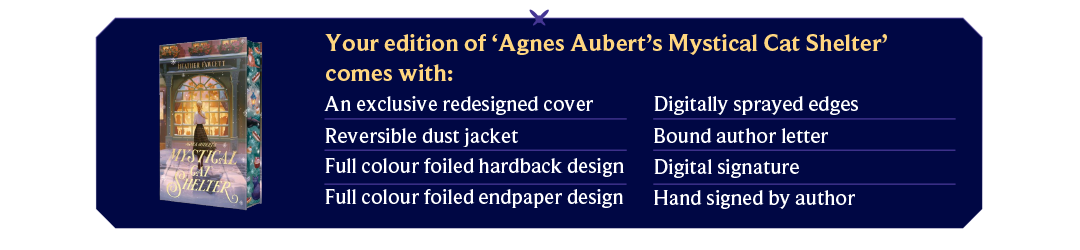
What is your favourite thing about the FairyLoot Edition of Agnes Aubert’s Mystical Cat Shelter?
There’s one little easter egg actually, on the endpages. There’s a painting on Montreal, which was initially just going to be a landscape, but the artist was kind enough to change that to make it feel more authentic to the city, so I loved that!
Blog Post Copied to Clipboard
Most Recent Stories

Community Features
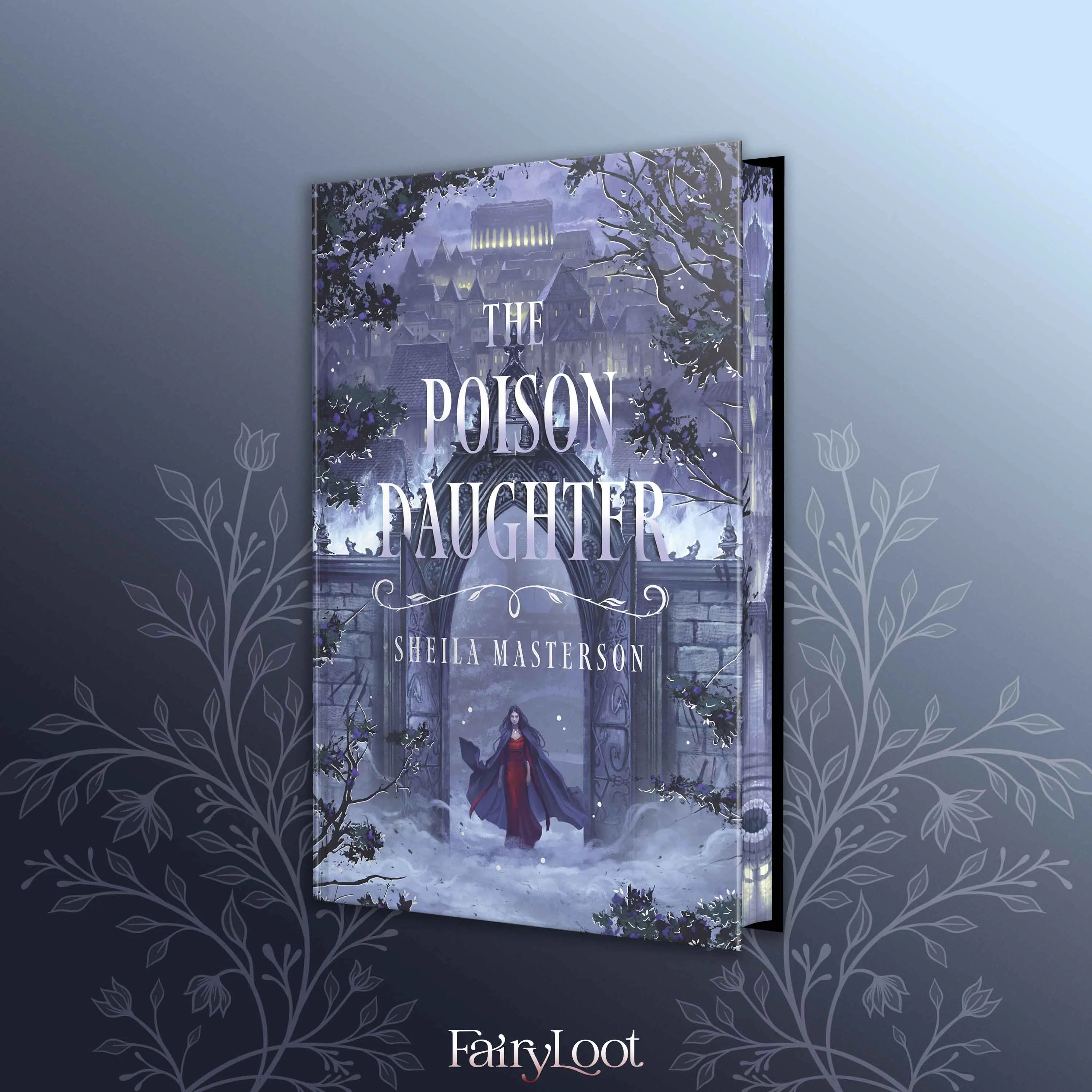
Dark & Delicious Gothic Fantasies to Sink Your Teeth Into
Jenni
14th October 2026
Follow Us
Most Recent Stories
Community Features
Dark & Delicious Gothic Fantasies to Sink Your Teeth Into
Jenni
14th October 2026
Follow Us
-

Community Features
Dark & Delicious Gothic Fantasies to Sink Your Teeth Into
Jenni
14th October 2026
-

-


Conversation
0 Comments