

Get the inside scoop on ‘The Last Starborn Seer’!
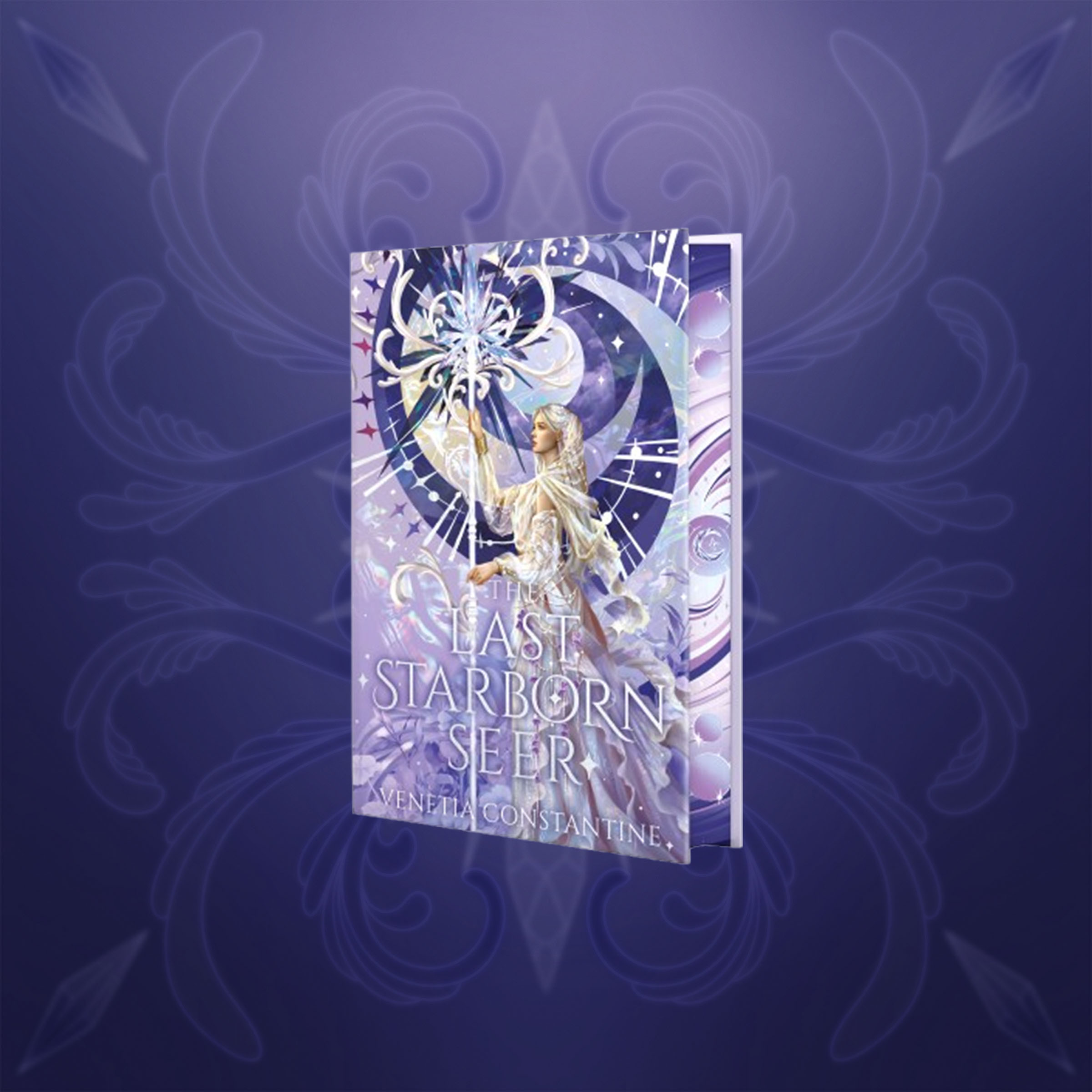
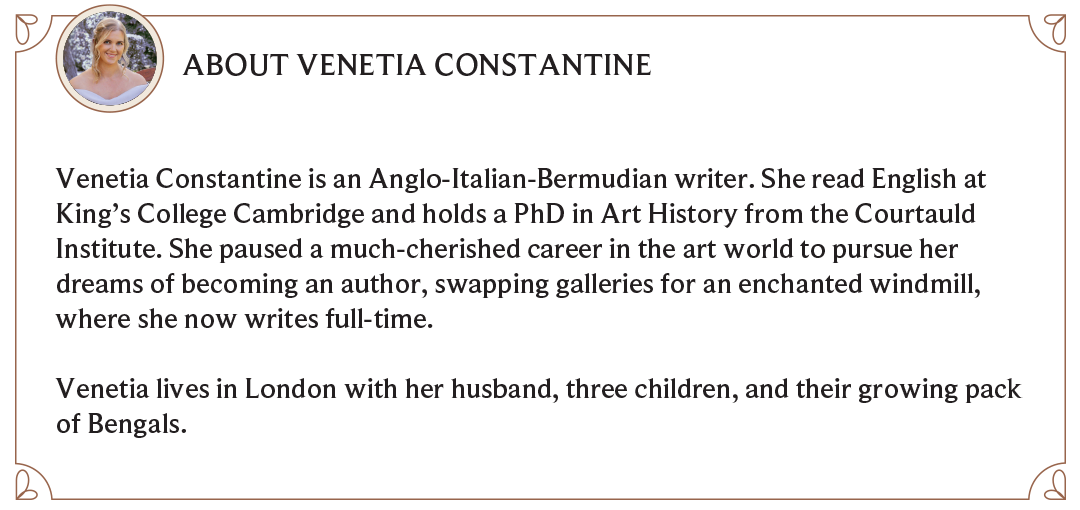
Venetia Constantine is the author of our March Adult ‘As The Stars Foretold’ featured book: The Last Starborn Seer. Read on to get the inside scoop from inspiration to favourite scenes and more!
What was the initial inspiration for your debut book, The Last Starborn Seer?
The idea of Arcelia, the idea of a dying world with elemental magic, has been with me since before I can remember, before conscious thought! There’s actually a word for it, it’s called a paracosm, and it’s something that happens to a lot of people. And then occasionally, it will become something that is put to the public and it becomes a heterocosm! I still have the notebook of the first written record of my book, from when I was six or seven. But it actually started before then, as I would tell my mother versions of this world when I was really young walking with my sister to school. So it’s been with me forever! It’s hard for me to say, but I will say it probably grew out of the fact I was a hugely avid reader as a child, and just obsessed with classic fantasy. I used to listen to The Hobbit on cassette, I read all the Narnia books, and other books like The Last Unicorn which is a huge source of inspiration to me. So all of that, combined with being a child of the 80s, having environmental concerns as that was a huge cultural touchstone at the time and was something I took really seriously as a child, I think those two things conflated and that’s where the idea came from. But also, as well as a world that has constantly stayed with me as I’ve constantly been scribbling in notebooks developing the world and the characters and the story, I didn’t sit down to actually properly write it until 2018, and that was triggered by a very specific incident. I was in a coffee shop waiting for my eldest daughter to get out of school, and a gang of armed robbers broke in and it was quite a violent armed robbery. I ended up being locked in a bathroom with six complete strangers, waiting until the police came and we were safe to get out. It was awful, and I developed quite severe PTSD and had a massive mental health crisis. It came out of nowhere and blindsided me, and I was very sick and in treatment. There came a point where living in the real world just didn’t feel like something I could do anymore, so I escaped into my imaginary one. And what I think happened, the final missing piece of the story came together. I had the idea of the plot and the world, but what was missing was the central character arc. And it then become a story about a young woman going on a journey of healing alongside her world. That was the missing piece, and then it just flew out of me!
If you could describe The Last Starborn Seer in three words to someone who hasn’t had a chance to pick it up yet, what would they be?
Ethereal, adventurous, and nostalgic!
Arcelia is a very vivid and epic world. Can you tell us about the challenges you faced bringing it to life?
So as it’s a world that’s been with me for a very long time, like layers of rock, it just slowly built over time. It is big, there’s four realms that are loosely based on elements, and they’re microcosms so they have very different climates and terrains. There was a lot of research that went on to flesh out all those realms, but the biggest challenge for me has always been how to present the information and which parts of it where. This book has been through many different versions of itself. It has always been dual POV, but when I first started writing it, one was a different POV. It was always Leilani, my main character, but it was also a character from a prequel timeline who is technically the villain of the piece. And I loved that version of the story, but it was really long and incredibly complicated. I decided to remove that prequel timeline, so it’s now a mystery that you uncover across the whole trilogy, and I changed the focus of who was telling the story to a different character.
Can you tell us about the research you had to do for this book?
I think I have a very two-part approach to world building. Because on the one hand, I’m someone who absolutely loves to be transported when I read fantasy; I think it does it better than any other genre, it has that sense of wonder and enchantment that I love. And so that means I do enjoy a quite whimsical and ethereal world build, and Arcelia is very high fantasy. It’s very divorced from reality, there’s amethyst moons and opalescent rivers. There’s things that don’t exist in nature, which you wouldn’t think would have to be heavily researched because they feel much other to our world. But actually, I’m also someone who wants my world building to feel very grounded. I’m a huge Margaret Atwood fan, and I remember seeing her in conversation and she was discussing how everything in The Handmaid’s Tale has happened somewhere in history and that truth is often stranger than fiction. And that is something that I do subscribe to in my own world building. So, although I’m writing what is hopefully a transportive, magical, ethereal world, I actually want it to link back to things that have actually really happened. For example, in Estelia, which is the Northern, mountainous and ice-bound realm, there’s the opalescent river that glows. And there is actually a river in Columbia which is rainbow coloured, and it’s that way because of a type of water plant. So I take reality and translate it through a lens of wonder, and I do like to have a visual language per realm, or a few different touchstones. For Estelia for example, I wanted something that was quite feudal in it’s structure, quite regimented and vertical in its aesthetic. So my mind went to renaissance hill towns, and I researched a lot of those and the ghost cities. And one of the characters jousts, so I did a lot of research on jousting reenactments. Every tiny detail that you will see in this book, had some level of research.
What themes did you want to explore within the story?
I think the theme that’s been there the longest, and which to me is still the most topical, is the idea of the dangers of living in isolation and radicalisation. When we enter the story, the four realms are living in total isolation from one another. There’s been a lot of war and prejudice built up on all sides, but it’s through the found-family in this book that those prejudices start to get broken down. I think the importance of remembering there’s a shared humanity with all peoples is something I think, particularly now in an age where we are seeing increasing polarisation, is for me most important. Another thing I wanted to explore was generational trauma and the effects of it. I was obsessed in my teenage years, and still am, with Wuthering Heights. I think just seeing how trauma can shape people and the accumulative effects it can have over generations, that is something I wanted to explore. Also, ecological collapse and the climate crisis was something that was there from the very beginning, and is even more topical now. There is this sickening curse that is effecting the four realms and bringing them all towards ecological collapse, and exploring that was really important to me. And also, the idea of fate versus free will as well. You know, discussing how much choice do we have to shape our futures, was something that was also really important to me.
Let’s talk magic! We’d love to know how you crafted the magic, what rules and systems you put in place, and any issues you faced with it.
The magic system is elemental. There are people in the world, a minority, that are born branded with an affinity to one of the four sources of elemental power, and they can channel two types of magic. Magic is expressed a bit like fingerprints, so everyone has slightly different powers even if they are within the same elemental affinity, but there’s light lore and shadow lore, and both have costs. Light lore is slightly less powerful and is temporary, but it is physical, and shadow lore is a lot more powerful and causes a permanent eroding to your spirit and mind. I have always been really interested in magic with cost; I think that probably came from reading so much Tolkien, with the ring and how it corrupts Frodo. I have also always been fascinated by the figure of seers that have existed in literature and throughout history because it’s a huge burden to know what’s going to happen. The challenge when writing any magic system is you want to write it to have rules and not just be convenient. And the other challenge of writing a character who is a seer is that it can remove suspense; because obviously if they know things, it can flatten it. In book one that isn’t so much of an issue, as Leilani is growing into her powers and the visions she gets are not always reliable or consistent, but as we move through the trilogy that will become different. But for my world there will be graded system of visions, she will receive some visions that are 100% going to happen, and some visions of things that are still in flux. But that’s definitely a challenge when writing characters with foresight.
We follow Leilani and Astrophel’s point of views throughout the story. How would you describe their individual journeys?
So I chose to have those two characters as the POV characters, because we begin in their realm and I also think they go on the biggest journey across this first book, so it made sense to follow their stories. I think what is interesting about them is that they are at odds with each other for a lot of the book, but actually they’re quite similar. They were brought up in a very similar culture so a lot of their world perspectives are the same. And they both, for very different reasons, are socially ostracised and both are desperate for acceptance. There’s a lot uniting them, but they get ripped apart from each other and made to dislike each other from early childhood. So I think it was interesting watching them go on similar, parallel journeys of having their world blown apart and having to expand their mental perspective on everything. In a way, it’s about watching them slowly come together, but the different thing between them is that I would say Astrophel’s a difficult character, particularly in the beginning as he’s been radicalised, used and intentionally twisted. But he is on a more obviously upwards incline, whereas Leilani’s character arc is also going up, but then she has magic that is corrupting her, so it’s a bit more jagged. I wanted to achieve them moving in parallel lines and then slowly and hopefully coming to a place of friendship, and maybe more.
Your writing style is very ethereal with lots of lyrical prose. How did you come to develop it?
I think this is a really interesting question, as there’s so many things about writing that you can hone and refine and learn. But voice, though, is something I think is quite innate. It’s something you can work on and as an author, you would be able to modulate that voice so you’re able to give your characters slightly different voices. But I don’t think that the way I write is something that is conscious, it’s the part of writing that you can’t teach, really. You can hone it, you can refine it, but people’s voices, by their very nature, will be them. And so I think whatever people see in my voice, is probably a product of all the things I’ve consumed. I’m someone that loves poetry and reading poetry. I love classics, and I’m someone who pays attention to alliteration, assonance, and literary devices when I’m writing. It’s something that is in my nature, that, not consciously, I’ve been trained to do.
As a debut author, what’s a piece of writing advice you’d give an aspiring author?
Firstly, don’t call yourself an aspiring author. If you write, you’re a writer, and I really feel there’s a lot to be said for claiming that identity. And the next thing, is to finish what you’re writing. Now it depends because people write differently; some people draft slowly and they get things to a more polished point, and there’s others like me who draft really quickly and we do lots of iterations to improve it. But I think, if writing slowly and taking your time, and going over it over and over is working for you, then that’s wonderful. If, however, you’re getting stuck and paralysed in this perfection cycle in your first few chapters and it’s preventing you from actually finishing it, I think it’s so key and there’s a huge value to be able to finish whatever you’re writing. Because you can’t edit and you can’t do anything with it, unless you have the story down.
What lesson would you love readers to take away from the book?
Above all else, that sense of wonder! I would love them to feel that they’ve been transported, because to me that is what fantasy does better than anything else. And in terms of a lesson, I think that idea of being able to love yourself in your completeness, with all your flaws, and accept that.
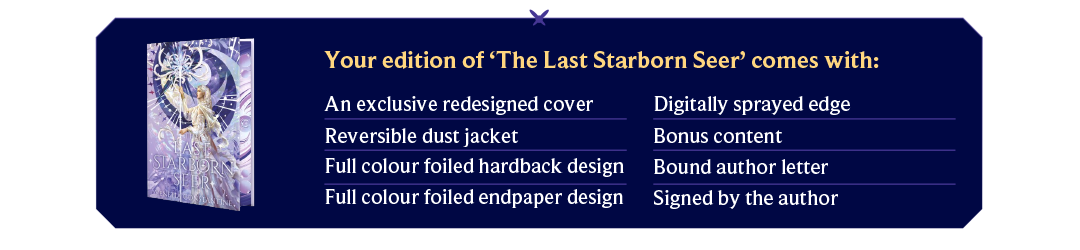
What is your favourite thing about the FairyLoot Edition of The Last Starborn Seer?
Obviously I’m biased, but I do think this is one of the prettiest you’ve ever produced! I’ve been a FairyLoot subscriber since early 2020, and I’m now a subscriber to the Epic, the Adult, the YA and the Romantasy. I am a huge lover of the books you produce, so as someone who has literally all of them, I really, really think this is one of the prettiest! I love everything. It’s very much how I would have envisioned my book, and I know that because before I even knew that this would be a FairyLoot book, I had commissioned who did the endpapers and the cover art to do a piece for me, independently. No one knew that, and so then when I found out he would be doing the art for this, that solidified for me that we had very similar creative visions. I think it is just beautiful and I love it!
Author Recommends
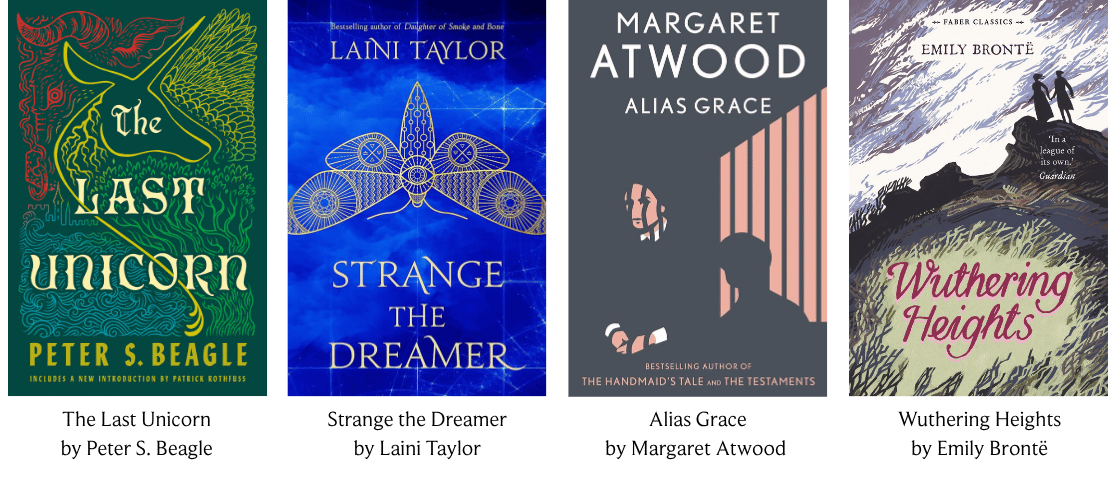
Have you ever wondered which books your favourite author thinks are an absolute must read? Well, wonder no more! Here are four books Venetia Constantine thinks everyone needs on their TBR:
Blog Post Copied to Clipboard
Most Recent Stories

Community Features
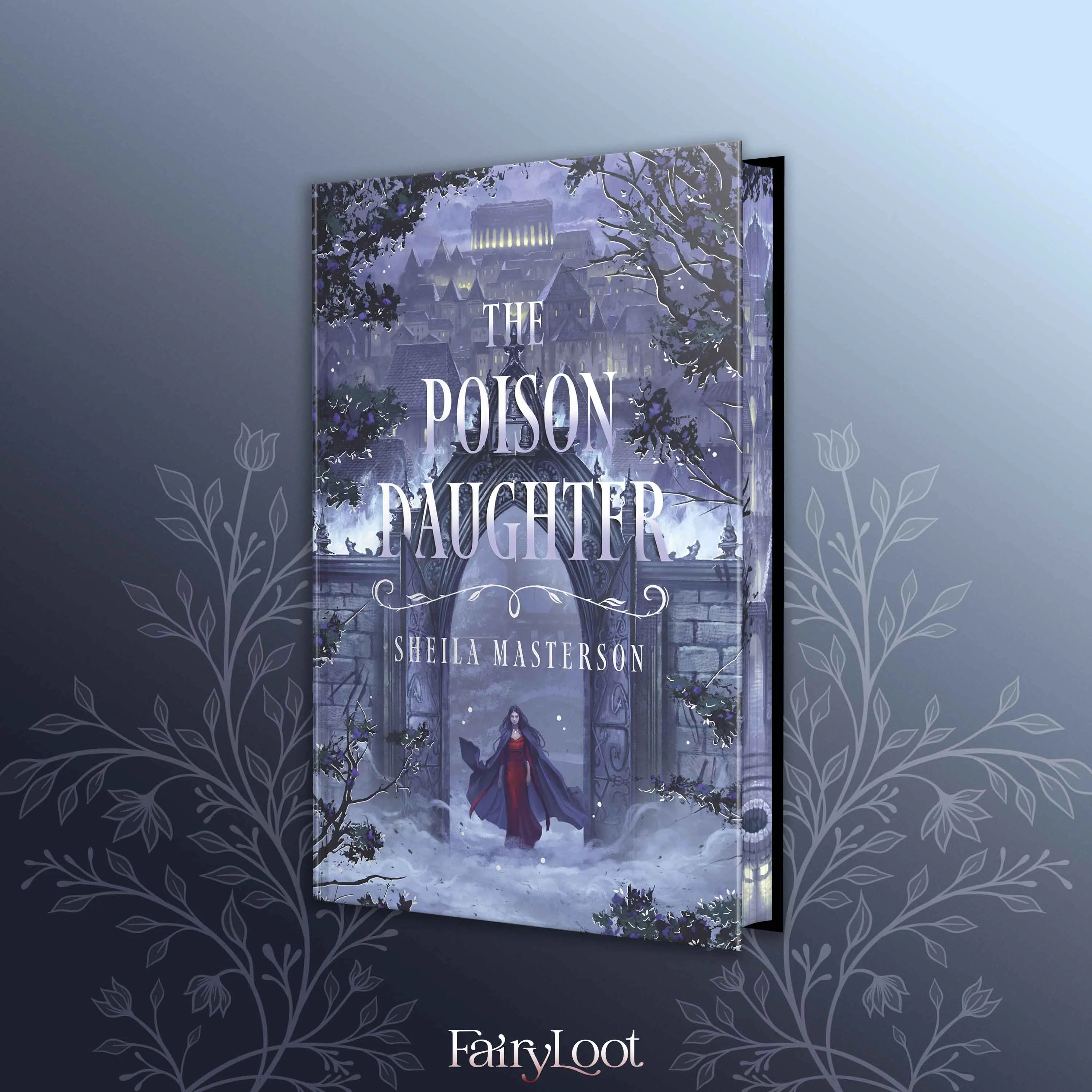
Dark & Delicious Gothic Fantasies to Sink Your Teeth Into
Jenni
14th October 2026
Follow Us
Most Recent Stories
Community Features
Dark & Delicious Gothic Fantasies to Sink Your Teeth Into
Jenni
14th October 2026
Follow Us
-

Community Features
Dark & Delicious Gothic Fantasies to Sink Your Teeth Into
Jenni
14th October 2026
-

-


Conversation
0 Comments