
Get the inside scoop on ‘Alchemised’!
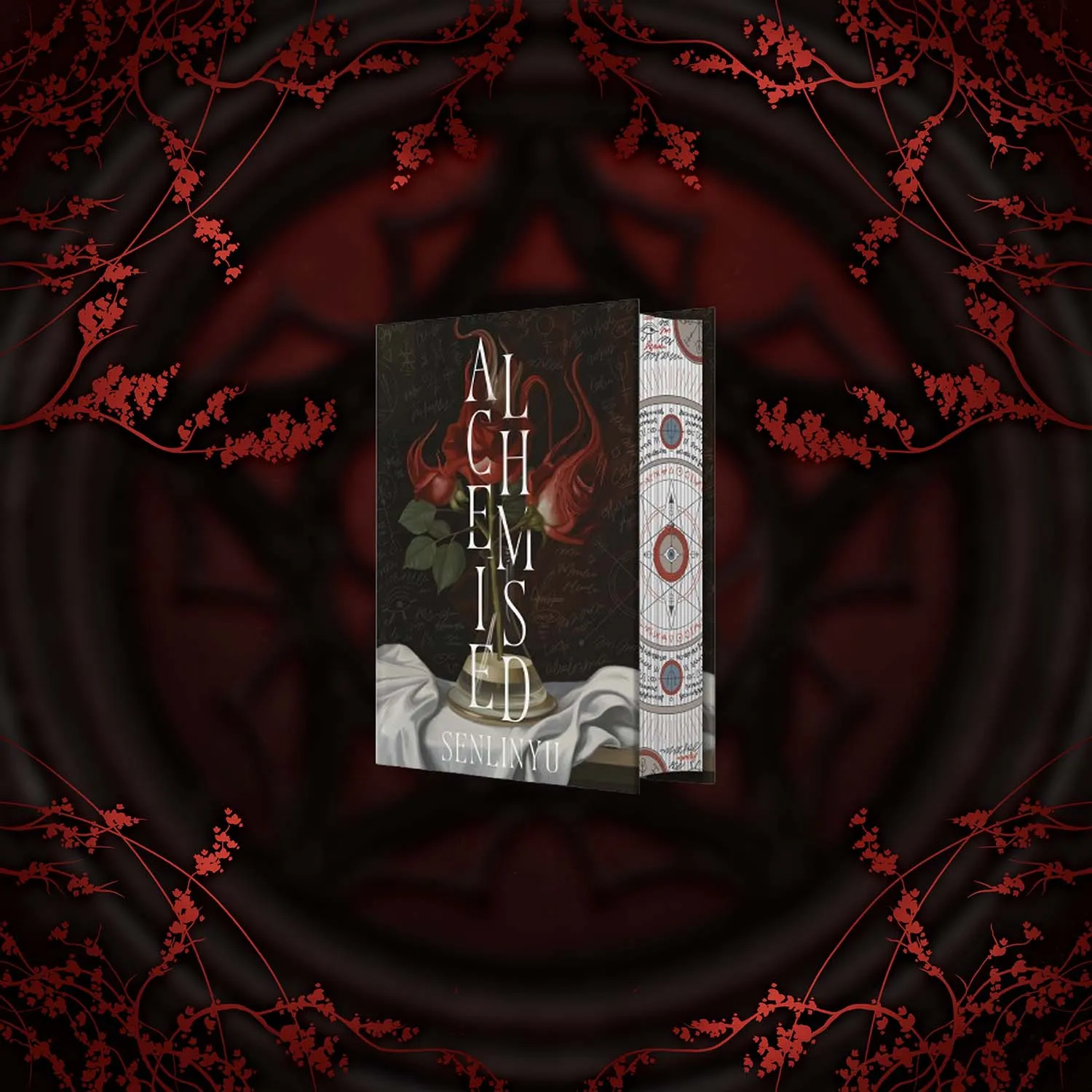
SenLinYu is the author of our September Adult ‘Memory & Malice’ featured book: Alchemised. Read on to get the inside scoop from inspiration to favourite scenes and more!
What inspired you to write Alchemised?
A big part of it was that I was reading a lot of fantasy and romantasy at the time, and I realised war was usually written as a backdrop or used as a stage for things to happen. I feel like I wanted to write something more so about the trauma of it, the way that it twists people, the way it damages people, and the way that those scars don’t go away. I wanted to explore the grey areas, and write a story that doesn’t have a neat ending. Whilst I get that for stories the narrative is a very important part, it felt like it flattened some of the complexities that were being dealt with in some of the stories I was reading, so I wanted to write something to see if it was possible do.
You have described Alchemised as a gothic, dark fantasy. We’d love to know what your take on gothic is as it’s such a widely interpreted genre.
I did some specific research into the gothic literary genre; what is was, where it came from. Most of it was about the period of romanticism and the literature movement that looked more into the terror, the taboo, supernatural forces and dark desires. And when it took over in the Victorian period, they really tried to reconcile all of these existential things that were going on. England was a very religious country at that time, but there was also industrialisation and the push against religion so people were having to grapple with their identities, with what they believed and with social pressures, and gothic literature became a space in which those things got to be explored. And then feminine gothic in particular explored women’s place in society, the idea of women having desires or feelings that were considered taboo, and so Alchemised really leaned into the feminine gothic traditions, exploring what it meant to be female in a very patriarchal society that views women as weak, that views femininity as a defect, and the way in which the interiority of the character and the environment she’s in mirror each other. And then on the supernatural element that exists in gothic literature, there is the magic system. And whilst I wasn’t really thinking about that as being the gothic part so much, the story’s exploration of love as a force and as this supernatural power that drives people to these incredible extremes, that causes them to be twisted or altered in ways and to go over lines they thought they would not cross; those were also the gothic elements that were woven into the story.
The book explores the realities of war, the nature of survival, and the mortal ambiguity of power. What drew you to those themes initially and how did they develop over time?
Growing up in the US, especially in the parts I am in, there’s an obsession with WW2 and the way that America featured in that war and the idealisation of it. And that was very interesting for me because I am half Japanese and my grandparents were interned during WW2 because they were Japanese. That was part of the American participation in WW2 that people did not want to talk about, that did not fit into the narrative of the US being this wonderful saviour that came in and helped. And so I grew up with this scepticism and this awareness that there are many parts of the narrative that just get left out, so when I wanted to write about war, those were things that I specifically wanted to write about. I wanted to broaden the view of war and I wanted to push back against built-in ideas of war and heroism.
Can you tell us about the world you built? It’s very vast and utterly fascinating!
I started with a lot of research. I had always wanted to study alchemy, I thought it was an interesting protoscience. It’s been so formative for a lot of things; expressions we use, and there’s a lot of concepts in Christianity that came from alchemical ideas because that was the science at the time. So when I realised for this story I could put the necromancy element in and the combat ability for the other side, and also deal with the socio-political elements of being able to make gold and things like that, I could put all of these things under the umbrella of alchemy. That gave me a reason to deep dive into studying alchemy to my heart’s content. I didn’t want Alchemised to be this wholly new world that was completely unrecognisable, it was more that I wanted to take some of the same assumptions and ideas that exist in our real world and society, and use creating a second world to rearrange the furniture and allow people to look at things in a different light. By utilising alchemy that has such deep roots in western thinking in science and religion, etc, it let me take a lot things and challenge their existence.
How did you navigate writing the complex relationship between Kaine and Helena?
I wanted to explore the idea of love, but not as a redeeming or inherently pure thing. A lot of the stories that I grew up reading tended to treat love as inherently pure, and if someone did something out of love that meant that it was redemptive and that you had to forgive them for the other things that they had done or that it was for good reason. And I really wanted to take that love but do a Black Mirror version of it, say what about when love goes too far? So that was where conceptualising their relationship came from, wanting to create a relationship that had this obsessive-ness built in to it, this desire to save or protect somebody, but wanting to question does that make their actions forgivable?
Did anything surprise you as you were drafting Alchemised? Whether it was the characters, the story, or the world?
The thing that surprised me most was that when I started with alchemy, I thought that I was going to have to bend it a lot to make the real world concepts mould with the fantastical elements that I wanted to create. And then as I was doing all of this research, I realised that a lot of it was all rooted in the same philosophical ideas of Aristotle and Plato, and basically all of those things attributed to the themes and the issues that I wanted the story to address. Instead of having to bend those alchemical base concepts and philosophical ideas in order to complement the story I was writing, it turned out that they just wove together perfectly on their own.
What do you do to get yourself in the headspace to write?
It depends on where I’m at in the process. I tend to start with a lot of research, and I like to start with a large pool of information and knowledge that seems relevant to the subject matter, reading any books or articles I can get my hands on. And then when I feel ready, I start drawing ideas, but I have to have a very deep pool to draw from. I don’t like to draw from a shallow pool where I’m having to jump to conclusions, so that’s when I’ll sit back and think I have to go back and do more research. Then I move into the drafting phase, where I start outlining things to get an idea of the feeling, the ambiance, the atmosphere, whose perspective I’m writing from, what this character is like, whether I’m going to be writing in first or third person, etc. I’ll start experimenting to feel out the right recipe to create the story I’m wanting to tell. Once I get to the revision phase, that’s when I know I’m going to be working on a particular chapter or scene, and I use music to get into the headspace. I’ll be running full scenes in my head, whilst listening to the music, really trying to sense of how I want the story to be and what the feeling is that I want to communicate. I sometimes listen to the music on the walk back from taking my kids to school, and then when I get back I shut the door, turn off the music, and then I just start writing and try to transcribe what has been running in my head.
Which character came more naturally to you and which was a little harder to write?
Helena came very naturally. The way that I wanted to explore her and the way that I wanted her to see the world, I had a very specific vision for that. The alchemy that exists in Alchemised is specifically western, so I knew I was creating a European inspired culture, but I didn’t want to write as oh, well obviously that’s European inspired, that is just the default for fantasy. So to have Helena be an outsider, to have her question things that those around her don’t, she doesn’t have any of that default acceptance which gave me the ability to have her interrogate the world she was in in a different way. When crafting that sense of otherness, the duality of simultaneously wanting to belong and yet seeing flaws and wanting answers, I was accidentally thinking of Fanny Price from Mansfield Park in that she’s very observant and she has this sharpness and sarcasm. Being in a place where you’re beholden to people and yet you still have these observations and criticisms but you know you’re not allowed to say them, a lot of those things naturally went into Helena’s character. The character I found more difficult to write was Luc’s. The complexity of developing him, communicating him to readers, and crafting the relationship that he and Helena had despite the fact he’s dead and he’s dead right from the first chapter. Creating this emotional attachment, and finding the right ways to show and share their relationship, that was definitely the hardest.
If you could have any power from Alchemised, which one would you choose and why?
Oh gosh, that’s hard! I think I would just want to be a metal alchemist. I don’t think I would want be a necromancer, and pyromancy is more dangerous than it is useful.
What is your favourite thing about the FairyLoot edition of Alchemised?
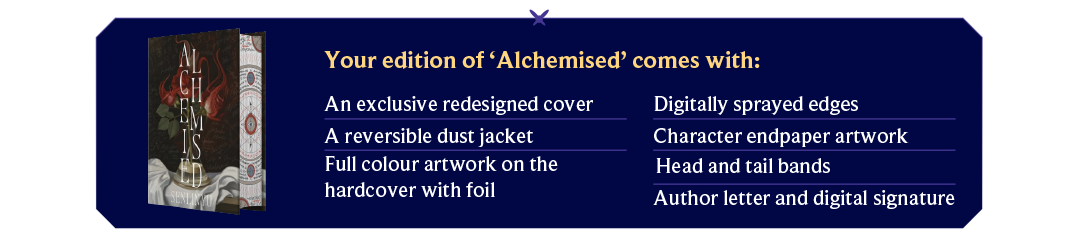
The whole thing just came together so well! I was mostly involved with the endpapers and the cover itself, trying to get the rose petals to look the way I envisioned. I wasn’t as involved with the sprayed edges, so when it was sent to me and I saw the whole thing, the way that the edge and the cover with all of the reflective texture all came together was just so perfect, I love it! In a lot of ways I can’t say oh, this thing is my favourite, because it’s the way the whole package melts perfectly. It’s so deeply satisfying!
Blog Post Copied to Clipboard
Most Recent Stories

Follow Us
Most Recent Stories
Conversation
0 Comments