


Get the inside scoop on ‘Fallen City’!
Adrienne Young is the author of our November Adult ‘Fated to Fall’ featured book: Fallen City. Read on to get the inside scoop from inspiration to favourite scenes and more!
What was the very first spark or image that led you to write Fallen City?
It started with the setting which is really abnormal for me actually! I typically don’t begin developing books that way, but this was just a setting that wouldn’t let me go. And when I originally sold this book, it was back in 2020, so the story itself has changed a lot since then, but the setting has stayed exactly the same! I’m a real lover of dystopian and post-apocalyptic stuff, and this is a historical setting that has those elements, too. It was also heavily inspired by a trip I took to Rome, and I just had to write it! The story then got built around the setting.
So was this a really different process compared to how you have written your other books?
Yes! Over the past couple of years I’ve been in the process of uprooting and restructuring my entire creative process, and this book was the guinea pig of that! Everything I thought I knew about writing books and developing stories, I turned it all on its head, and experimented a lot. I started with a different foundation and it went down a really different path.
How would you describe the heart of Fallen City without giving anything away?
It has a really big heart, but the heart is very wounded! There’s a lot of pain in this book, and a lot of angsty romance, too, but it all has this sense of mourning over it. I had to really lean into that to let this book become what it was meant to be. But it does have a back door to a very hopeful narrative.
Was there a particular mood or atmosphere you wanted readers to feel while reading Fallen City?
The city itself is a walled city, and it has been destroyed by war. The gates are closed, people are stuck inside, and it’s a far cry from the glimmering, beautiful beacon it once was. So for pretty much the entire book, you’re in this container that is very dusty and rubble-y. But the city is situated near the coast up on the cliffs, and whilst you can’t see the sea, you can smell it and at times hear it. I really wanted to create a mood that was paradoxical, where there is beauty hiding underneath which I think helps people to hold on to hope. I was really intrigued by bringing those two things together.
Several relationships in the book feel strained by power, secrecy, or loyalty. Which dynamic was the most interesting for you to explore?
I think the dynamics between the two main characters and their mentors was what kept me most excited throughout the creative process! Luca is a novice to Vitrasian, a philosopher, and Maris is a novice to Ophelius, a priestess. But these mentors also have their own agendas, and play a part in directing Luca and Maris’ fate which is how their destinies get tangled. It really does all come back to those two women! It’s not until retrospect that you really see it, but I was obsessed and really struggled to not make more of the book about them!
The story explores many layered themes, but at its heart is the complex relationship between Maris and Luca. What drew you to giving their relationship a more star-crossed dynamic?
Their dynamic is very much rooted in the broader themes of the plot; of our nature as humans to return to war over and over again. Luca and Maris represent two different perspectives on that type of conflict and they are both trying to stay true to their ideals and convictions, only to find out that they’re both wrong — there’s no right way to do war! And we’re in such a weird time globally that it’s at the forefront of my mind. The themes and root of Maris and Luca’s dynamic is kind of representative of that inner war within myself, too. Like, how do you deal with conflicts of this scale? Because Luca is very much an unwilling symbol that gives birth to this rebellion and starts a war he didn’t mean to start, but that’s not what he set out to do. He’s coming from a place of justice and revenge, whereas Maris is coming from a much more intellectual perspective, coming more from the diplomatic side that’s very corrupt, but she believes she can change it. But neither path works! Neither path is able to avoid getting blood on their hands. And everyone in this book is either wrong or damaged in some way. I think that’s the thing that bonds them together so deeply, but at the same time, that’s also what’s keeping them apart. The whole arc of their relationship is them trying to navigate that to find themselves in the middle somewhere.
Some of the characters appear very different depending on whose perspective we’re seeing and where we are in the timeline. What drew you to exploring that kind of complexity?
It was a logistical structure problem actually! From the time that I sold the book to the time that I was actually writing it, the story had become this whole monster! I sold this story as two books, but then once I really developed the background of what was going on, there was just so much happening! Originally, I wasn’t going to have a past timeline, but then I realised that it was way too much to cover all inside their heads and for them to keep remembering. I had to put all that information somewhere, in a way that the reader would get the information and context that they needed, but also in a way that they would remain engaged in the story to avoid them skimming and getting bored. I also loved the stuff that happened in the past so much that I thought the story wouldn’t do it justice unless the readers actually got to go into those scenes and experience them. So that’s how the dual timeline came to be!
What kind of research or preparation went into building the world of Fallen City?
I love research! I do more research than I have to really, both because I enjoy it and because I also use it as a procrastination thing! Other than historical research, I spent a lot more time than I expected on the military research. There is so much to research on the Roman legion as they kept excellent records. I went through a lot of deconstruction and reading accounts on sieges and battles that they fought in, and became fascinated with their resourcefulness and creative thinking, and just understanding how they did what they were able to accomplish in that time period. Obviously these are really bloody, terrible things, but it’s just unbelievable to me that they were able to develop those systems.
What was the most challenging part of writing Fallen City?
Probably the structure, and figuring out how to tell such a big story in just two books. It just kept growing, and trying to make it fit was honestly a refreshing challenge. It was like a puzzle, trying to fit all the pieces into place. Although it was fun and invigorating, it was also the biggest challenge.
How do you hope readers will emotionally connect with this story?
I hope readers who are feeling a bit disillusioned with the world feel comforted. Not that it makes it okay, but we’ve been doing this since the beginning of time, and unfortunately there’s something in our nature that we haven’t evolved out of yet that brings us back to these very regressed states over and over. I find that a bleak reality, and even though there’s no answers in the book — there’s no good guy or bad guy, there’s no right way or wrong way — I hope readers that feel a little hopeless feel comforted. And for the readers not coming at it from a frustrated place, I hope they enjoy they setting! Cultures all over the world are fascinated by Rome, and so I hope people feel like they’re almost able to tour around it like a tourist and explore this setting that I love so much. And of course I hope they get the angsty feels from the star-crossed lovers!
What’s your favourite thing about the FairyLoot edition of Fallen City?
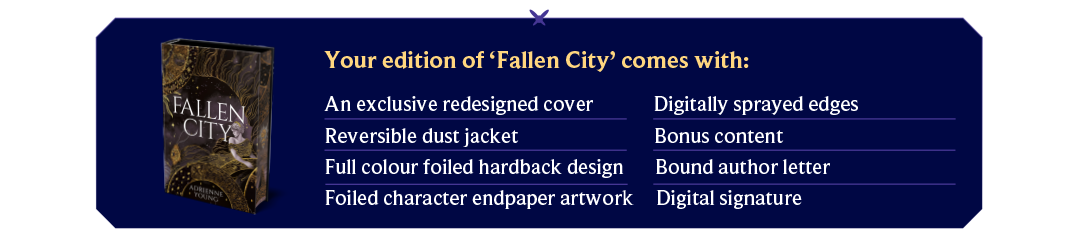
Oh my gosh! I don’t know if I’m allowed to say this, but I think this is the most beautiful edition of any book I’ve ever had! I’m so in love with it, and I think it’s because it’s my personal taste. I have had so many beautiful special editions of my books, but the artwork, the colour palette, the gold foiling, this is everything I’m personally drawn to. When you started sending me the artwork I was like oh my gosh, oh my gosh, it’s so pretty! I think my favourite part is all of the astrological elements that are woven in. That is an element of the book that is one of my favourites, and it comes to play a lot more in the second book. If everything was up to me and I got to choose all of the aesthetics and things for this book, it would have focused a lot on that. The FairyLoot edition is like just what I would have made. I can’t say enough good things about it! It’s going to be front and centre on the bookshelf.
Blog Post Copied to Clipboard
Most Recent Stories

Community Features
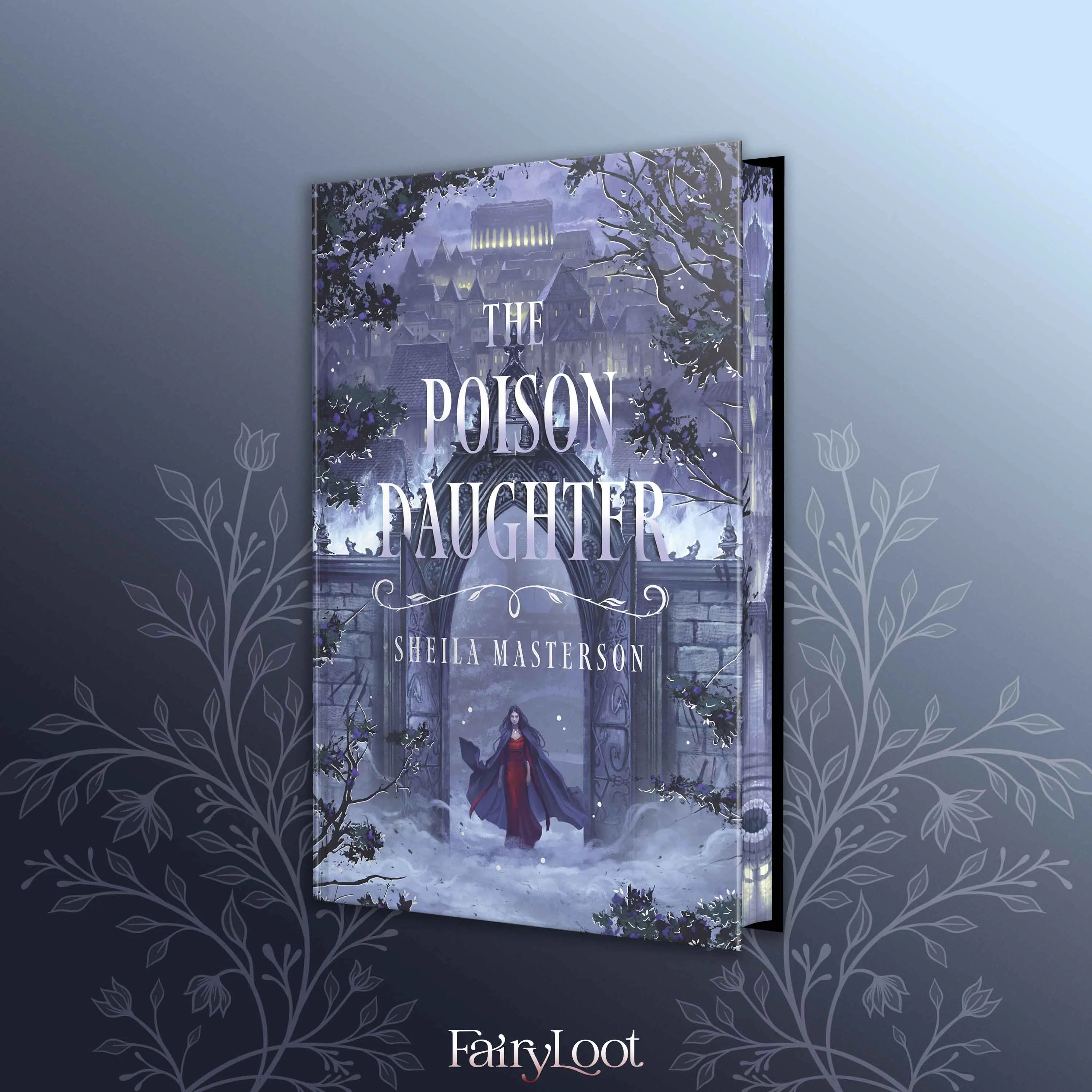
Dark & Delicious Gothic Fantasies to Sink Your Teeth Into
Jenni
14th October 2026
Follow Us
Most Recent Stories
Community Features
Dark & Delicious Gothic Fantasies to Sink Your Teeth Into
Jenni
14th October 2026
Follow Us
-

Community Features
Dark & Delicious Gothic Fantasies to Sink Your Teeth Into
Jenni
14th October 2026
-

-


Conversation
0 Comments