

Get the inside scoop on ‘Her Hidden Fire’!
Clíodhna O’Sullivan is the author of our March Young Adult ‘Dangerous Devotion’ featured book: Her Hidden Fire. Read on to get the inside scoop from inspiration to favourite scenes and more!
Can you describe Her Hidden Fire in three words?
It’s searing, it’s sexy, and if you’ve ever been exploited, I hope this makes you feel seen. So searing, sexy, and seen!
Her Hidden Fire has Irish inspirations. Could you tell us about the folklore, mythology, and/or landscapes that helped to shape the story?
I’ve been thinking a lot about this lately, and I sort of feel a bit of a fraud. I have that luxury of having a hybrid culture, because on the one hand, yes I grew up speaking Irish so the Irish language is in there and the landscapes are in there. But the thing is, I also grew up reading Tolkien and Narnia, and all those classic Welsh, Scottish, and English fantasies. For me, what Her Hidden Fire is, is this hybrid mix. It’s not as if I can say that Irish people invented dragons or castles or any of those things, which are all in the book as well. But I felt very lucky to publish a book that has, for example, old Irish names in it. The names are all based on Ogham which is old Irish, a kind of tree-based language, so most of the names mean a letter of the alphabet that is also associated with a tree. And also, a lot of the places are based on real places that I know and love. For example, the dark academy that they go to is based on Ardgillan Castle, which is the castle on the east coast of Ireland near where I live. It’s really beautiful, but it’s also a little bit forbidding, and you can imagine dark magic happening in dark corridors. Certainly for me, part of what fantasy is for is escape and a sense of wonder. And sometimes, I think when you’re writing about somewhere that you really love, your own sense of genuine wonder will hopefully come through.
In Domhain, the magic system is male-dominated, with females rarely becoming Channellers. What sparked this idea?
When I was growing up, it was just the water you swam in. When I was in school for example, girls had sewing classes and the boys were sent out to do football, and the girls had housework while sons were left out to play. So that’s the world I grew up in; I was told from the get-go with almost every other girl in my generation that you’re just that little less valuable than your brothers, and as a consequence, you are going to have to work harder and sacrifice more. So Éadha really reflects what I grew up with, she’s just trying to help and be useful because that’s where she see’s her worth, and it takes her a long time in the story to realise that she’s just as entitled to have a destiny as anybody else.
We uncover a dark cost to the magic system. Was this something you decided early on, or did it develop over your writing journey?
To be honest, the springboard for the whole book was that it was going to have a cost, the idea that the magic would be built from exploitation and that the magic is drawn from the life force of people. I grew up poor, my dad was an alcoholic, and I had a place in college but I had to give it up because of my dad’s gambling debts. So when I was around seventeen and eighteen, I was working as a fruit picker, and on factory production lines and cleaning toilets and that, and I saw a whole lot of exploitation. I was very much thinking why have we built our world like this? You know, with a few people at the top who are having a great time and then there’s a whole lot of other people that are really not having a good time. And to be honest, I think it’s only gotten worse since I was a teenager. So, sometimes I think you set out to write a story because you’re trying to answer a question that you have yourself. Because then what happened to me, I saved up some money and put myself through college and I did law, and all of a sudden I felt like I was becoming the bad guy, because I was managing teams of people and being told to reduce headcount or get them to work longer hours. It’s almost like, is the choice really between being exploited or being the exploiters? Which is kind of what the question is in Her Hidden Fire for the three central characters, because it’s the system and they can’t just bring down the system single-handedly. They’re all just trying to survive in it. They’re all trying in their own quiet ways to not become exploiters, but at the same time, not be found out and coming to a sticky end.
What is your approach to writing relationships that feel complex and emotionally real, without giving too much away?
I will be honest and say it was the thing I was the worst at when I wrote the first draft. I’m autistic and very much an ideas person. In secondary school, I was really bad at reading social conventions, of how you’re suppose to know stuff and also how you’re supposed to know how not to say things. So I used to get bullied quite a lot in school, and also by my family at home, for being the one that blurted stuff out and said things. The lesson I had taken away from all that was I was really bad at dialogue and speaking and saying stuff, so I had all these characters and they weren’t talking because I thought I was going to be really bad at it. In the first draft, I actually managed to have the whole story, the whole adventure, dragons and all, with hardly any dialogue! Thankfully, a manuscript reviewer was like listen, you maybe need to make people care more about these characters, and for that they need to to talk to each other. So I realised I needed to stop self-sabotaging because I really like to write and I like all the other parts of writing, and the way I learned to write dialogue was by going on walks. You kind of have obsessive conversations with yourself when you go for a walk, you’re replaying conversations and have running dialogues in your head. So I discovered, me sitting and staring at a laptop wasn’t the best place to come up with good lines, but going on a walk up the beach or down the lane was. I would come up with something and jot it down in my phone and expand upon that.
What made you choose dragons over other mythical creatures?
As well as exploitation, I was also thinking a lot about the givers in our society and how they really lose out. In other words, we sort of take for granted that there will always be people who will be nurses or teachers or firefighters; it’s just assumed people will always take low pay for really hard work. And in my lifetime, I just feel like we’re increasingly treating them worse and worse, and so I wanted to write a book on can givers ever win out against the takers? The takers are the ones who accumulate a lot of wealth and are willing to exploit loads of people, whereas the givers are the ones that quietly just do the right thing. But the problem is, Éadha is my hero in this book, but her power is based on her own heart and her own strength, and she is underpowered. So when I set out writing the book, I actually didn’t know if or how she could beat the Channellers, and there was this moment about half way through where I was like ohhh, dragons! I realised that might be something that adds an extra dimension, and if there were to be a connection between her and the dragons, it might make for a more even battle. This kind of comes out a bit more in book two, but dragons, for me, are also a metaphor for how when people are abused and picked on by bullies, part of how they respond are talons and armour. You build up this wall around yourself when you’ve been used one too many times.
As we’ve discussed, Her Hidden Fire features some very important and deep themes. How did you manage to balance this for a YA audience?
I suppose I do have the benefit of having teenagers to chat to, and I think young adults now are more aware of inequality than ever. Yes the themes are dark, but they’re fundamentally about the fact that there are some people who will absolutely exploit other people, and that really affects people’s quality of life. Because if you’re being worked really hard on a really low wage, and you can only afford to live in a s****y place, and you can’t pursue your dreams because you’re exhausted by your day job; all of that is super familiar even for seventeen, eighteen, and nineteen year olds. So I was fairly comfortable writing about that stuff as young people are very aware of just how imbalanced some stuff is at the moment.
Do you have any go-to rituals or snacks that power your writing sessions?
Oh, definitely! So I have a day job and I have three kids, and people often talk about it like the third shift. You know, you’re often very, very tired and I do have to sort of bribe myself to get going. I have playlists for writing and coffee shops that I go to, and if they have spicy carrot cake when I’m in a coffee shop, then I know it’s going to be a good writing day! I’m not someone who can get up at 5am, sit at a writing desk and get cracking. I load up on caffeine, load up on sugar, have a playlist pumping, and then I can finally manage to get going.
Do you have any advice for aspiring authors? Other than get lots of caffeine and spicy carrot cake!
It took years and years of rejection for this book to get published. I wrote the first draft, and it got an agent really quickly, but then it didn’t sell on submission and that agent left agenting, so I was back to square one. Then I went out on direct submission and got a publisher quite quickly, worked with them for a year, and then they went bust on publication day. So we edited and I had printed copies of the book and all, and it just never saw the light of day. At that stage I had already started on book two, so I had two little book children and I thought I wasn’t going to get them out. And at a later point I went to the cinema with my kids and we were watching Trolls, and there’s this bit when Anna Kendrick sings Get Back Up Again, and at that point I had been rejected for the umpteenth time so I was in floods of tears! But I was like yes, I will get up again! So the lesson I’ve learned is, you are allowed the feel the disappointment when you get rejected, as you probably are going to get rejected multiple times when you’re trying to write. For me, what works is, allowing yourself to feel that disappointment and have that cry, but then the next day I’ll be sitting with my laptop eating carrot cake, filling up of caffeine, and going again. But the fundamental thing though, is that you have to want to write more than you want to get published. Because if getting published is what you’re really doing it for, you’ll probably get so many rejections before you get a yes that you’ll give up. Whereas if you still want to write even if you keep on getting rejected, then you’ll keep going. And the other piece of advice I have is that editing is like a superpower. When I look at the book I have, there are sentences that are like seven, eight years old, and then there’s sentences that are six months olds. There’s ideas in the book that are five years old, and ideas that are nine months old. The amazing thing with editing is, is that you can take all your best ideas and best sentences and best work, and you can put them all together and turn it into something you could never have done in one single go. But because you have had lots of goes and lots edits, only the best stuff has survived and the old stuff has been replaced with better stuff. Editing is the best of you across time, and that’s such an amazing thing to have and show the world.
What is your favourite thing about the FairyLoot Edition of Her Hidden Fire?
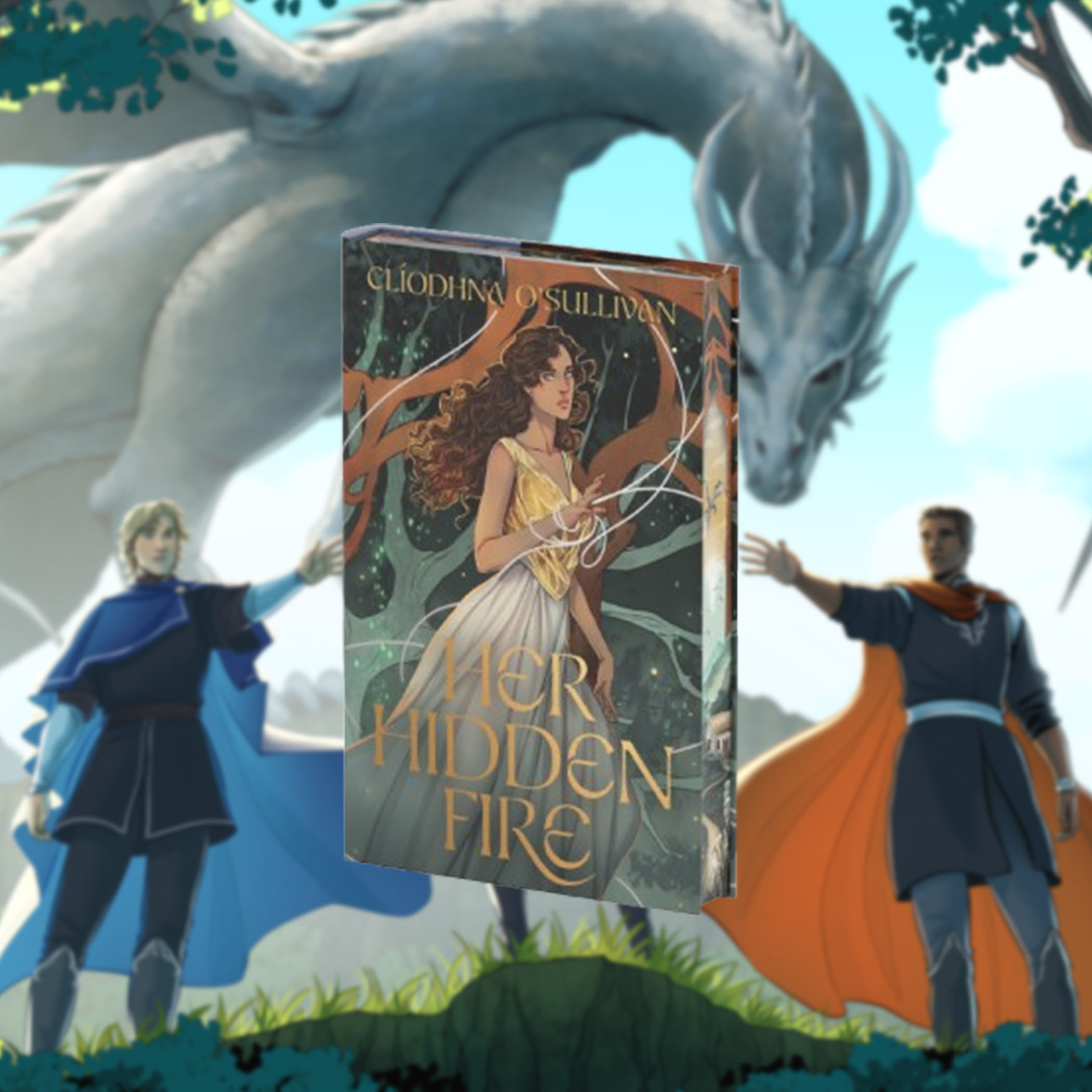
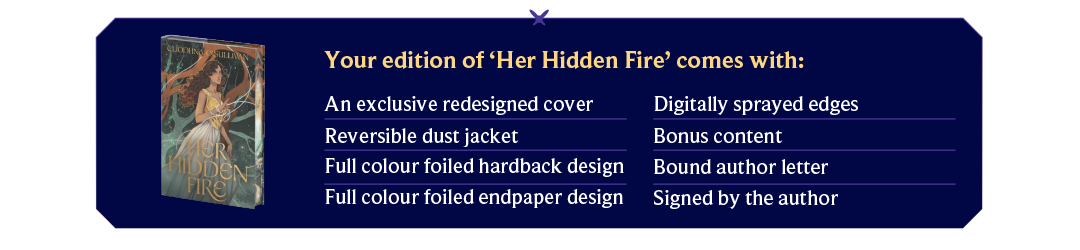
I just love everything about it! Like look at the little dragon on the sprayed edges, and the little thatched cottage! Oh my god. It’s a tie for me between the sprayed edge, and the dress on the front cover. The dress is such an important thing in story as it’s a symbol of courage, so the fact it made it to the cover and it is so beautiful with the gold thread going through it and everything, I love it! It makes me so happy. And the overlays are gorgeous as well!
Blog Post Copied to Clipboard
Most Recent Stories

Follow Us
Most Recent Stories
Conversation
0 Comments