

Get the inside scoop on ‘The Book of Fallen Leaves’!
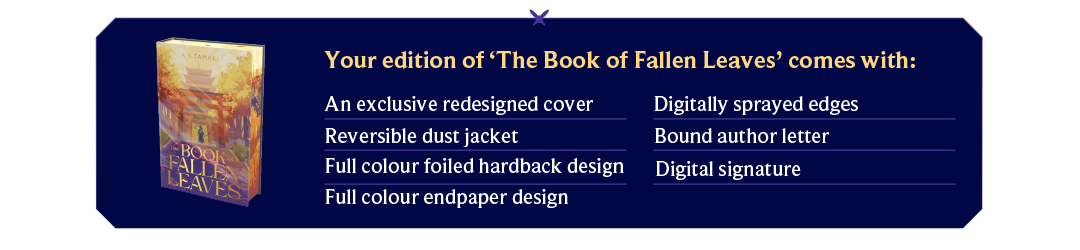
A. S. Tamaki is the author of our Quarter 1 Epic ‘Blades of Dynasty’ featured book: The Book of Fallen Leaves. Read on to get the inside scoop from inspiration to favourite scenes and more!
What sparked the idea for The Book of Fallen Leaves?
The original story that was the inspiration for this, a 900 year old samurai saga, is one of the foundational texts in Japanese folklore and mythology. I often say it’s kind of like The Iliad and The Odyssey, in Japanese folklore. So I grew up knowing the original story of the heroes, the villains, and the magical things that happened in it, and that was just in the back of my head for a really long time. I had been working on a couple other projects for a while, but I had this idea of two characters floating around in my head, but I didn’t know who they were yet. I didn’t know exactly what their relationship to each other was, either, but I did know what the emotions felt like. I just kind of explored that for a while, and all of a sudden, one day it just clicked that this would take place in that world. I also had been reading a lot of epic fantasy, and I had been seeing so many more stories in sci-fi and fantasy that were not based on the standard medieval England, Tolkien-type thing. Which I love, of course! But that has been the standard for all of modern publishing, and so I was really excited that I’ve had a chance in the last few years to see this growth of other cultures being explored. So it all came together in my head, and I realised that this was a story that I could tell based on the culture I came from and and where my family is from; it has a really personal significance to me.
The book features Japanese and samurai influences, history, and lore that you grew up with. Did you have to carry out any more research, and how did you put your own spin on this?
A lot more research! I will say that I studied history in school. I’m a huge history nerd, and I probably would have done research even if I didn’t really have to! But yeah, massive amounts of research, massive amounts of looking things up, finding Japanese primary sources and then frantically calling my dad to help me understand them better, as he’s able to read Japanese better than I can. And the other cool thing about this story is that the actual folk tale itself is based on real historical events, so there’s two layers going on at the same time in terms of the things that inspired my novel, so now I’m kind of the third remix of all that stuff. But whilst it’s very heavily historically influenced, it’s not historical fiction. It takes place in a secondary world, it’s not actually Japan but it’s very similar in a lot of ways and very different in others. So for me, the really important thing was getting the broad strokes of this story. The architecture of the actual events, the story that inspired me, is the backdrop to the novel that I wanted to tell. But the actual plot and the main characters are their own thing. It was also important for me to get the tone and the flavour right, as I really wanted to pay homage to the culture and the place that I came from in a legitimate and authentic way. As much as I love anime and manga, sometimes they play fast and loose with history. For me, that can be just as cool, but this story was about trying to be as authentic as I could.
You’ve described the vibes as Shōgun meets A Song of Ice and Fire, meets Princess Mononoke. What drew you to these other tales, and how did they help you shape the story?
That is a great question, and they all have different answers! To start with A Song of Ice and Fire, that’s obviously the biggest titan in epic fantasy for the last 30 years. It felt a little dangerous to me, with my publisher, to compare my little debut novel to such a behemoth. But George R. R. Martin’s ability to encapsulate characters so quickly and so strongly, that always stuck with me. And that combined with the big, sprawling mosaic of a world that he’s weaving together throughout all of the books, is really fascinating to me. Shōgun, is an interesting case, as the original novel is having a sort of resurgence now that the TV series came out a few years ago. Which was excellent, I thought! But the book itself is a complicated conversation, because it also had a huge impact on English literature and English pop culture; with samurais and ninjas, it was kind of groundbreaking. But every Asian person I know, has very mixed opinions on it and its portrayal of Japanese culture. So, I can recognise the groundbreaking steps it did make, but to me personally, when I look at it, it does very much feel like a product of its time and dated. But it tells this great story with an epic, mythological sweep, and it is also inspired by real historical events as well, so the history nerd in me loves that. And Princess Mononoke is another story I grew up with. And that world, where the gods and spirits just exist in nature, the entire fabric of the world itself just being infused with these creatures, that is very firmly routed in Japanese mythology. So it feels like the air I breathe, and especially when I was writing this story, in terms of the mood I was hoping to create.
The book follows multiple points of view. Why did you choose to tell the story this way, and did you have a favourite POV to write?
There’s a few reasons. One is that I knew going in that I wanted to tell a big story, and I knew that I wanted it to have that sort of epic canvas that I was just describing, so I had to at least try to weave in that kaleidoscope of perspectives. And then on a technical level, I knew that there was going to be elements of all sides of this war that has happened, and that we would need to see the picture from multiple points of view. And then also, I am a big fan of The Expanse series by James S.A. Corey. That’s science fiction, of course, but just like in A Game of Thrones, it does follow the same kind of structure in that each chapter is limited to one person’s point of view. That’s a really common thing in this genre, so it just felt like the natural course to take. And my favourite point of view? I mean, that’s the classic trick question, right?! How can you pick a favourite child?! I will say that Rui is really, really special; the real heartbeat of this story. Her voice came through so strongly, and it just came to me. I didn’t really have to do any work to bring her to life. There was obviously a lot of work to refine and edit and other things, but she came through very, very strongly.
Sen, an exiled prince, and Rui, a peasant girl, are contrasting protagonists. How did you find that balance to ensure they feel equally central to the story?
It was an important thing for me, to think about telling this epic story of gods and monsters, political schemes, and all of those things. But I wanted to make sure that I focused on regular people, as well. Chances are, if any of us were born in medieval times or any time period in history, most of us would be farmers, statistically speaking. Very few of us would be kings or princes. And let’s face it; most of the big, epic fantasy stories that we’ve heard of are only King Arthur, or the royal court, or princes and knights and all that. But I wanted to hear stories about regular people and how they struggle. Especially because this book does encompass a really big, brutal war, and regular people are the ones that are going to suffer the most. They’re going to have to find a way to survive and protect the ones they love, and be good people in the midst of this terrible world. That was really the guiding star of the series for me. And for me, that balances with the more high-status characters in the book, because they too are, for the most part, trying to be good people in this terrible world with terrible things happening. But the contrast and the synchronicity that you can see happening with the higher status and the lower status was really interesting to me.
We adored the camaraderie between Sen and Rui. What would you like readers to take away from their friendship?
One thing I thought about a lot when I was writing them was the difference between loving someone and being in love with them. This isn’t by any means a YA novel, but it does have a lot of elements of growing up for them. To me, that was the core dynamic of their relationship. In certain ways, they do love each other, and they have to figure out if they’re in love with each other. They may or they may not be, they may just be spirit buddies and really good friends. And that’s also something we really don’t see so much in fantasy fiction. I have nothing against a love story, but that is not them necessarily.
The Onryō are vengeful spirits driven by retribution. What drew you to demons who have motivations and purpose, rather than being purely a destructive force?
That is something, again, that’s really deeply rooted in real folk tales and mythology from Japan. Japanese history is full of ghost stories and tales of vengeful spirits. And many East Asian stories in general, in terms of supernatural things, tend to feature that kind of thing. But there is another element that goes back to Princess Mononoke in some ways, where spirts exist in our world, even if we may not necessarily be able to see them. But also, every thing can have a spirit, and humans can become gods or spirits themselves. There are a couple of famous historical figures, that in the folk tale version of their lives, because of something that has happened to them, become vengeful spirits when they die. And as we see in my book, they can’t find peace until they essentially satisfy that grudge, nor can their spirit rest. That aesthetic and thematic dynamic was very interesting to me, and it really fit with the idea.
We were instantly immersed in the breathtaking world building! Did you face any obstacles when creating such a rich world and culture?
My embarrassing admission is that one thing I knew when writing this story, was that it was my debut and a big epic fantasy novel, and it would help me if I could use real history and culture as a starting point, and then build outward from there with my own stuff. It was a benefit to me, not having to start everything from scratch, I admit it! For me, I would say the hardest part is balancing how much you take from real history and how much you change. And much do you have to keep in order to pay homage to the sources that you’re coming from.
How do you visualise and plan out an epic fight or battle scene?
It’s hard! You know it’s coming; as I write up to these big battles, I know I have to do it soon. And I will have little bits and pieces of it, but maybe I don’t have the whole thing, and it stresses me out so much! I have to really build up a lot of momentum and just get the engine running at full speed for me to feel like I have all the pieces and I’m ready to go. It’s like you’re training for a marathon! You’re training and training and training, trying to convince yourself that you have the energy to write it, and then you’ve just got the blaze through it as fast as you can. And it’s going to be really messy, have holes, and be all over the place, but at least now you have something, and then you can start to distill it and refine it and make it really good. I also think some of it does come from my screenwriting background and training, in the sense that it is almost impossible for me to write an action scene if I don’t understand the geography of where I am. Like what’s the set? What location am I at? What is the limitation of it? What is the world around me going to do to that fight or moment in the story? And those real world, tangible things, interacting with the environment and knowing the lay of the land, is really important for me to be able to visualise it in my head. And then it’s just a case of looping through it five-million times.
The prose is beautifully lyrical and immersive. How did you find and develop your writing style?
I’m a sucker for good prose! I did a lot of poetry studying when I was in school, as well. It’s really easy for me to take it a bit too far, I think; that’s probably one of my weaknesses as a writer. But, for me, so much of my reading experience and so much of the emotional experience that comes though as a reader, is through the prose. And I can remember visceral moments of books that just kind of punched me in the gut, because of the way they were written, equally as much as because of what was happening. To some degree, any writer is just going to be their voice, and so I tend to lean in that direction for sure. And as a writer, it is really hard for me to write if I can’t hear the music, if that makes sense. It just comes through inevitably from that process.
A huge congratulations on this incredible debut! Do you have any advice for aspiring authors?
It would vary depending on what stage of the process you’re at. But I would say that the fundamental first thing, for anyone that wants to write, is to just finish something. A lot of people have really good ideas, but a lot of people won’t commit to the time and effort it takes to write even a bad story. So just finish something, and then try to make it as good as you can, and then finish the next thing. And over time, you will get better. For me, in a more general sense, writing is a lifelong practice, and committing your life to something as a daily or regular practice that you devote to, is really important.
What’s your favourite thing about the FairyLoot Edition of The Book of Fallen Leaves?
Oh my god, okay. So first of all, the art is amazing. It’s beautiful! And the first thing that struck me about it is that it’s so different, but still so complementary, to the themes and the plot and the characters. I love how much it works in simpatico with the standard cover which leans much more into the epic, action-type vibes. And then the FairyLoot cover leans much more into the softer, more romantic and poetic elements of the story. Both of those two sides, for me, are equally important, so I love what a great counter point it gives to the original cover.
Author Recommends
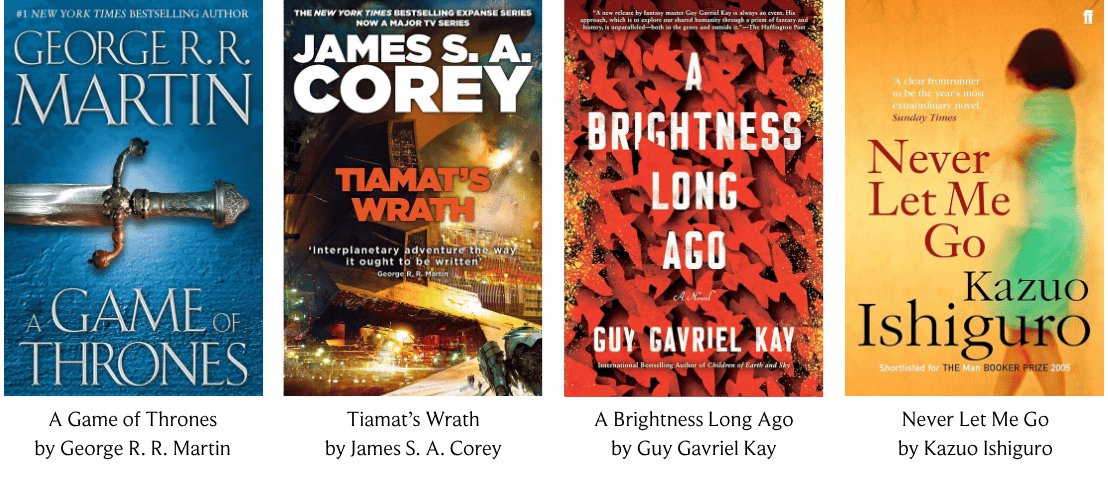
Have you ever wondered which books your favourite author thinks are an absolute must read? Well, wonder no more! Here are four books A. S. Tamaki thinks everyone needs on their TBR:
Blog Post Copied to Clipboard
Most Recent Stories

Follow Us
Most Recent Stories
Conversation
0 Comments