


Get the inside scoop on ‘Death’s Daughter’!
S. A. Barnes is the author of our April Romantasy ‘Deadly Affairs’ featured book: Death’s Daughter. Read on to get the inside scoop from inspiration to favourite scenes and more!
If you could describe Death’s Daughter in five words to someone who hasn’t had a chance to read it yet, what would you say?
My little elevator pitch I’ve been saying is: Buffy meets Percy Jackson for adults! That’s six words, but you get the idea!
The world of Death’s Daughter was very nostalgic, gritty, and atmospheric. How did you go about creating it?
You know, with some things I deliberately decide to create them, and others just kind of show up and I write them down. In terms of the university, I went to a university in a small town myself, so I just kind of pulled from that; the idea that the university is necessary for the town’s survival, and also that uncomfortable alliance that the town and the university have in terms of the money and the influx of kids from outside. Also, I’ve lived all over the place, but I’ve lived in small towns quite a bit, and there’s always an underbelly to it. People never think that, you know? But it is there, and to me, so much of Death’s Daughter and Jo’s life involves secrets, and people doing things that they don’t want other people to know. And the grittiness of it, I think some of that comes from my horror background. I just notice creepy, eerie stuff, so it sort of finds its way in there. If there can be a cemetery in a story, I’m going to put it in there!
Were there any shows, movies, or anything else that inspired Beecher?
Definitely Buffy, because I loved the idea of Sunnydale, where you have these people that live there that can see a menacing man disappear in a puff of dust, and they just don’t say anything! I loved the idea of there being a town with things that a lot of people don’t acknowledge or notice. Also, when I was looking at where I was going to set this, I deliberately chose the East Coast because in this country, that is where our old stuff is. I wanted a town with old stuff that has been built, destroyed, built back up, destroyed, and built back up again multiple times over the course of centuries. I wanted it to have that level of history; it’s not haunted, exactly, but it’s got a presence. That’s what I was aiming for, anyway, so I was looking at Salem and Danvers where the witchcraft trails and accusations happened. And as I said, I went to this small university. My sister actually went to the same school, and when she was reading this book, she recognised the courtyard and I was like, yeah, I snatched that!
We really enjoyed learning about the Old Ones and how humans found a way to rationalise them and their power through myths and legends. Can you tell us a little bit more about what they actually are and how you created them?
So I’m very vague about that intentionally. I sometimes have a hard time with fantasy, as I have a science fiction brain. So my brain goes this is a fantasy world which is nothing like ours, but we still have animals called horses and apples called apples. It sets off this sort of panic mode. So, I was looking at it more from my science fiction background, which was like these are entities that have abilities which are beyond what humans have. But, it’s like a food chain; humans think they’re at the top, but they’re not, and that’s where I really wanted to play with this. So, the idea of where they came from, or what they actually are, is sort of left purposefully ambiguous. Because to me, any advanced technology is going to look like magic to someone who doesn’t understand it. I enjoyed looking at this and thinking, if you’re human and you see this happening in front of you, what are you going to do? You’re going to make up a story about it to make it make sense! That’s how we communicate to each other and warn people about things that are potentially dangerous. That’s where we’re getting our vampire lore and where we’re getting our gods and demigods, and the things that they have seen that have made the stories.
What themes were important for you to explore in Death’s Daughter?
Of course there’s magic, very attractive men, sexy times… all that stuff is in there! But for me, I was actually thinking about the larger metaphor. You know, in Buffy, they were operating under the idea that high school is literally hell. In this case, I’m looking at when you’re that age, in your early twenties, you’re figuring out who you want to be and who you think you can be. That’s influenced by your parents, your home environment, and what you don’t want to be. For some of us, there’s a genetic component to some things, there’s nature vs nurture and all that stuff. But essentially, I was looking at this idea of looking where you come from and figuring out who you want to be in contrast or comparison to that. Maybe your parents are workaholics or they’re abusive or whatever; Jo has all of that but she’s also Death! I wanted that to be a metaphor that I hope everyone could relate to, trying to figure it out and maybe realising that you can’t leave behind the parts you don’t like, and trying to live with that. I was also looking at power, and how you use it morally and ethically, and where is that line.
We loved Jocasta’s character a lot, she was very complex but extremely funny at the same time. What challenges did you face when writing her?
I think the thing with Jo is that she’s really walled off because she doesn’t ever feel safe with anyone. There’s always a line, even when she’s with her friends. They love her, and she loves them, but she’s keeping a big portion of who she is hidden. And when she’s with Devon, who knows who she is, she’s still holding herself back because she doesn’t want to be like him. So she’s in a difficult spot, and I think she was fun to write. Her internal monologue is how I cope with things; my brain is always running, and I think Jo has that too. She uses humour because I think, quite frankly, that’s the easiest outlet for her. In fact, sometimes she uses sarcasm to the point where she hurts or offends people around her to an extent, because they don’t understand that she’s trying to cope. She’s like, I am taking this seriously, but if I don’t laugh or say something funny I’m going to fall apart. The hardest thing about writing Jo was figuring out the ethical and moral dilemmas she has with taking life and being Death’s daughter, and how to get across her reluctance. She’s being dragged through a journey of development, but how do you do that without being repetitive? How do you make people care that this is happening to her? That was really hard.
Which character was your favourite to write about?
I’m a sucker for secondary characters that break things up. I love writing Daan and Chessa, because Chessa is a badass and she’s amazing, and kind of keeps Jo grounded. And I love writing Daan, because he’s just so innocent! He has no idea what’s going on, and no one is telling him, and he was just so fun to write because of that injection of humour. To me, giving Jo a fully fleshed out world with friends and former roommates and people she doesn’t like from her dorm, all of that stuff was really fun for me because that made it feel more like a populated universe.
What did you do to get into the writing zone?
I am the worst procrastinator in the entire world! So for me, it’s very much about routine and schedule. I have an office that’s separate from my house, and leaving my house, being away from the pull of unread books and streaming shows I want to watch, that really helps me. And then, I have to turn off all social media on my phone because otherwise I will just wander forever! I’m not a plotter in the traditional sense, but the first thing I do when I’m here is sit down with a notebook and work through what I think a scene needs. Where am I, what happens in this scene, who is involved, what is the outcome I’m looking for, does that match the people that are here, etc. So, I just kind of sketch it out, with words, not drawings, and just let myself make a messy first draft of it. And I have coffee! A beverage of some variety, usually a warm coffee but today I’m drinking an iced one, is required. And then I have noise-cancelling headphones and music with no words. I love writing to classical music, but lately it’s been a 80 HD focus playlist on Spotify! It’s got a nice beat to it but doesn’t have anything to distract you.
What do you hope readers will take away from Death’s Daughter?
The ultimate thing I want them to take from it is joy. I want this to be a thing that they read and they were, like, kicking their feet and having fun with it. My whole thing with writing has always been, if I can, I would like for my books to do what books have done for me. That is, when life was rough, I could open a book and be someone else for a while. And this book, it brought me so much joy just to write it! I would like people to feel that feeling of escape.
What’s your favourite thing about the FairyLoot Edition of Death’s Daughter?
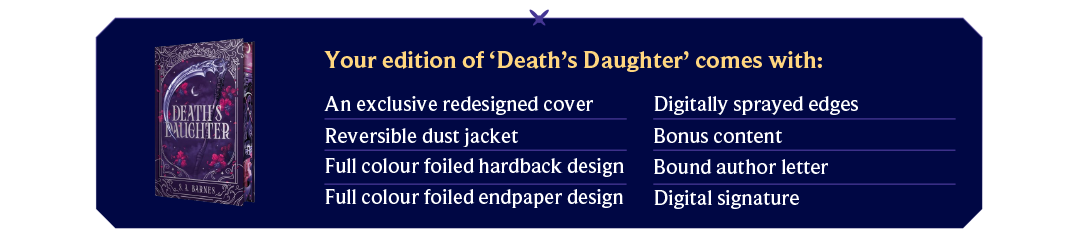
That is probably the hardest question you’ve asked me, because it’s all so beautiful! It’s just gorgeous! I think, if I had to narrow it down, I always love seeing character art, so seeing the endpapers with both Devon and Carter, I was like oh my god! But specifically, what I love about the whole thing is the foiling and her hair! And the edges! I’ve never seen edges that intricate before.
Author Recommends
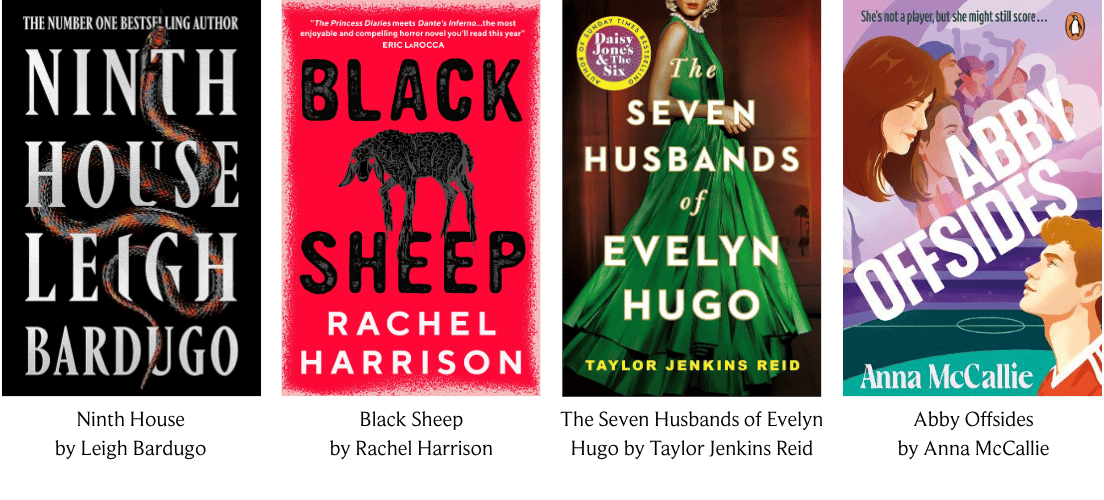
Have you ever wondered which books your favourite author thinks are an absolute must read? Well, wonder no more! Here are four books S. A. Barnes thinks everyone needs on their TBR:
Blog Post Copied to Clipboard
Most Recent Stories

Community Features
A Treasured Trope — Why We Adore Found Families in Fantasy
Jenni
20th August 2026
Follow Us
Most Recent Stories
Community Features
A Treasured Trope — Why We Adore Found Families in Fantasy
Jenni
20th August 2026
Follow Us
-

-

Community Features
A Treasured Trope — Why We Adore Found Families in Fantasy
Jenni
20th August 2026
-


Conversation
0 Comments