

Get the inside scoop on ‘The Unicorn Hunters’!
Katherine Arden is the author of our June Adult ‘Legends’ featured book: The Unicorn Hunters. Read on to get the inside scoop from inspiration to favourite scenes and more!
For readers entering The Unicorn Hunters for the first time, how would you describe the book in three words?
Haunted, mystical, and enchanting!
What first inspired you to weave the real history of Anne of Brittany into a fantasy novel?
I first encountered Anne of Brittany as a historical figure when I was sixteen and spent a year in Rennes, France studying. If you go to Brittany, even today, you see Duchess Ann restaurants, bars, and streets everywhere! There’s monument statues as she’s very much a Breton folk hero, in part because of her very vigorous defence of Breton sovereignty in the late 15th century, and, if you read about her actual story, she’s one of those people whose personality really shines through in her historical record. That is usually hard through official documents, but she loved music and she loved poetry and was a beacon of the arts before she married Charles of France. When she was a young woman, she ascended the throne of the Breton duchy under very difficult circumstances, and proceeded, as a teenager, to do everything she could to delay or prevent a marriage to France because she, as her father was, was very wary of being annexed by the French crown. She escaped raids to capture her, she got besieged and ran, and she schemed to marry somebody who was France’s rival! She did everything she could, and then at the end, she still ended up married to the king of France. So it didn’t work out for her historically, but she tried so hard, and as a historical fantasy writer it made me wonder, but what if there was magic? What if there were unicorns? What if the world was a little bit stranger? Or, what if she had been older? In history, she was only eleven when she ascended the throne. She was just too young, so I gave her ten more years. The great privilege as a historical fantasy writer is that you can say, what if? You take your liberties and hope other people enjoy them!
What made Anne the ideal heroine for this particular story?
You don’t know what somebody was like in reality; you’re making somebody up. But, I found her love for the arts relatable, and I found her stubbornness enchanting, as well as her ability to play politics at a very young age, her courage, and the fact that she kept trying her whole life to ensure Breton’s sovereignty, even after she married the king of France. She never gave up, and I felt that was so admirable. The Anne I made up is an Anne of my own imagining, but I found certain things admirable and relatable in her records and I wanted to reproduce them. Like, she was disabled, she had a deformed hip, but she still rode, she had special shoes made, and she just kept going! She definitely had fantasy heroine energy, in the confines of her own time and place.
What do you hope fantasy readers will learn, or become curious about, regarding the real Anne of Brittany after reading your depiction?
It’s so hard for me to sit and say I want this from my readers, because every reader reads a different book. Obviously I hope some will be curious, but some won’t be curious. Some will be more interested in the history, and some will be more interested in the fantasy. It’s impossible to think about every reader’s experience, and I think all you can do as a writer is try to please yourself, otherwise you’ll go crazy!
How would you describe Anne’s character arc without revealing where her journey takes her?
I was really interested in the medieval idea of the body politic, with the ruler literally embodying their country. In the novel, Anne is Brittany, and she knows this. Like, Brittany goes to whoever she marries, and her one big play she has to make to ensure her own future as well as her country’s is who she marries. She understands that no matter what, she will have to sacrifice Brittany and go live with her husband. She’ll have to give up the duchy and the administration of the duchy. She has accepted the limitations of the world she’s in and tries make the best of it, even if she has to sacrifice herself in the process. But as more magical elements enter the novel, she begins to think that there may be another option, that there might be a way to keep sovereignty and to keep the duchy without giving up everything she owns and everything she wants. And that’s kind of the arc of the novel — her discovering that it is possible to have a self and to be herself, and to be a ruler and also a person.
Your settings often feel like characters in their own right. What atmosphere did you want to create?
I love setting a scene. I spent a year living in Brittany myself when I was a teenager, at a formative age, about a 30 minute drive from the forest of Brocéliande, which major scenes are set at in the novel. Brittany was called Lesser Britain in the middle ages, because Great Britain is the big island and Lesser Britain is across the water, and its linked by weather and by culture to Britain. A lot of Arthurian legend can also be traced back to Brittany. And I guess I just wanted a sense of a haunted country. The green, wet, misty, slightly mystical and slightly haunted land. And I definitely lent into the classic; there’s castles, there’s knights, there’s armour, there’s sorcery, and a very clever cat. I wanted a classic fantasy energy, similar to the books I loved when I was a young teenager.
Unicorns can symbolise innocence, power, danger, and freedom. Which interpretation most influenced your portrayal?
All of them! That was kind of the point, because Anne starts out not only believing in unicorns, but they were also supposed to be an embodiment of purity. In this book you can only hunt a unicorn if you’re pure of heart in the classic sense, but also in the emotional sense. And then when the unicorn becomes real, it starts to embody freedom and power as well. Its interpretation morphs from the very classic innocent one, to a more expansive interpretation symbolically.
The novel combines political intrigue, folklore, and romance. Which element proved the most challenging to balance?
Fitting the folklore with the history was challenging, because you try to honour both elements but you don’t want to have the book swinging back and forth between a fantasy novel and a historical fiction.
Beyond the central romance, which relationship was the most rewarding to develop?
I liked Anne’s relationship with her sister, Isabeau, and I liked Isabeau and Elesbed who were friends. Anne’s sister was historical. In real life she died very young, but I obviously wanted her to not die young in this. I also write books for children, so I do like writing a child’s character. It’s a fun thing to try and write them in a way that feels like they are their actual age, but to not be too twee or cute. So I enjoyed writing her a lot, and I like writing siblings as it’s a fun relationship to try and capture.
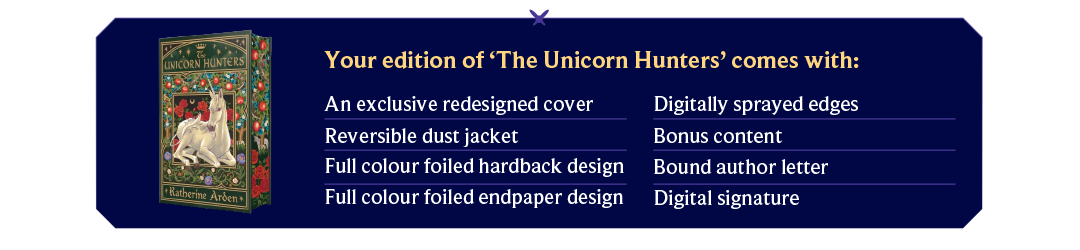
The FairyLoot edition is a unique, extended edition of the book. What can you tell us about the additional material?
It has expanded scenes! A lot of the scenes are longer, they have more dialogue, and there’s a lot more of the ghost wives. It’s just a longer, more detailed reading experience.
What is your favourite thing about the FairyLoot Exclusive Edition of The Unicorn Hunters?
Oh, the naked hardcover. It’s beautiful! I’m obsessed with it, it’s just like a tapestry. It’s really lovely, I love the Breton and French flag, the roses, the unicorn, and the text. It’s just absolutely spectacular! I love the foiled endpapers too of the characters, they’re really, really nice.
Blog Post Copied to Clipboard
Most Recent Stories

Follow Us
Most Recent Stories

Conversation
0 Comments