

Get the inside scoop on ‘Immortal Rose’!
Alexandra Bracken is the author of our September Adult ‘Everlasting Essence’ featured book: Immortal Rose. Read on to get the inside scoop from inspiration to favourite scenes and more!
Immortal Rose has such a distinctive regency-inspired fantasy setting. What drew you to this particular era and aesthetic?
It’s so iconic, the fashion and the aesthetic of it. It was a really interesting transitory time period, and I definitely cheated a little bit by having it be regency-inspired because I knew I wanted to pull from history and play around a little bit. I wanted to have a bit of fun with it, even if I knew my fellow history lovers would also be tearing their hair out by me taking some liberties! But, it’s such a fun and inspiring setting because it’s a world that has so much beauty to it, but it also has a lot of darkness. I got to explore the two dynamics, like the beautiful gardens but also the fact it smells terrible! Everybody is stinky, everywhere is stinky, and you can imagine that Viola has a really hard time with that because she’s a super sensory person, where she can smell people’s emotions and information about their lives. And what’s really interesting is that I entered the romance genre by reading historical romance. I was in my 20s never having read a proper romance, but my dad was diagnosed with terminal cancer and I was looking for an escape. I think I had that internalised misogyny where people think of them as pure smut, which is actually not true at all. I wanted to try Sarah MacLean’s debut Nine Rules to Break When Romancing a Rake, and I was just hooked! The thing I love about historical romance novels, especially set in the Victorian and regency era, is that a lot of the time they’re centred on family units and you read across different characters. Different members of the family are finding love and there’s just a sense of cosiness to it that I really enjoy. And I had the idea for perfume-based magic. Modern perfumery is so science-based, it’s a lot of scent molecules and it’s developed in a lab setting for the most part. So I wanted to move back in time, when perfumery was a great effort of having to extract the oils and locate them across the world yourself. Then, all those things just came together.
Where did the initial idea for the perfume-based magic come from?
I have always really loved perfume and fragrance. I’ve always used it in my storytelling, and I’ll usually find one candle scent and light it every time I sit down to write a book. I’ve done this for years and years, as it’s just a way to immediately bring you as the author into the story world. And as I said, I love perfumes, and I fell down the rabbit hole that is fragrance-tok and was learning more about the difference between niche perfume houses and designer perfume houses, learning more about the craft and the different notes. And the thing that really struck me was how perfume is a form of storytelling. Like, the perfumer is trying to convey a story or emotion or even a memory that they have, and communicate it, and the person who wears it takes it into themselves. They then have an interpretation of it too, and that’s just such a wonderful, beautiful art form to me! I remember thinking I was someone who didn’t like really floral perfumes; they gave me headaches and I especially didn’t like rose perfumes. But I had gone to Nordstrom, and I was sniffing a bunch of perfumes, and I had tried on what is now a very famous perfume called Delina by Parfums de Marly. At first I was like oh no, I don’t like this at all! It was so rosy and so tart from the rhubarb note. But then, as I was walking around the store, I kept returning to that smell and kept noticing how it was transforming on my skin as it was drying down. I thought that there’s actually something really magical about this, how what I’m smelling is different from what someone else would smell on themselves. I then thought about what if it was actually magic? And then, what if there was a scent-based magic system? It just escalated rapidly!
Fairy folklore plays such an important role in the story. Were there any particular myths or traditions that influenced your world building?
I feel like I have just absorbed so much fairy lore over the years, and it was fun to be able to approach it by putting my own spin on it whilst also trying to keep certain hallmarks of fairy lore. Like, where the fairies are strange, unnatural creatures rather than creatures of great beauty. But, I really like that the fairies of this world are very mysterious. You learn a little bit more about what happened to them in the second book which I’m very excited about! But, in this book, it’s very much an impression and a legacy that they have left behind. There are so many wonderful books that tackle fae, that I wanted to focus on the perfume magic and the little scraps of magic that they have left behind and run with that, keeping the fairies a little more mysterious for now.
If you could have Viola create any perfume for you, what would you want it to do, and what would you call it?
I have discovered that I am terrible at naming perfumes! I think this is one of the reasons that I don’t title my chapters, too. I have a newfound appreciation for perfumers and the people that name nail polishes and makeup and things like that. But, I think I would like a perfume that could allow me to focus in on my work, and make me not pick up my phone when drafting. To get into a flow state when writing gets harder and harder as technology integrates more into our lives. And I think I’d call it something like The Storyteller. I’ll take the perfume, give it a little sniff, and just dive into the story and write 10,000 words in one go! That would be amazing.
Let’s talk characters! Viola is such an intriguing heroine. What did you enjoy most about crafting her character?
In the very first draft of this book, Viola was more of a genteel, softer character, raised as an upper lady. That was sort of inspired by an editor suggesting that I try to write outside of my normal character type for heroines, as I tend to write very snarky, cynical, and jaded female leads. So I thought, yeah, let’s try that! But it did not go well, so when I was rewriting the book I realised I needed to give Viola more of a spark, more of a personality, and more of a defiance in this world. That conflict, that pushback, is something that really comes out on the page, and I think it is important as a reader to feel that tension, too; to feel that constant war between the character and the world, and how it’s changing or how they are changed by it. And in the second draft of the book, you see that she had a rougher upbringing. I got to use a lot of regency and Victorian era cant, which is like street slang and very colourful phrases and idioms, that I think really added to her character and rounded her out. And, it gave her a very interesting dynamic with the very prim and very proper Hugh!
Off the back of that question, what did you find most challenging about her character?
One of the challenges about her character is that usually, when a character walks into a scene, their first sense that they utilise is their vision. But with her, I was constantly having to remind myself that she would focus on the scents around her first as she can kind of smell what’s coming ahead of time. This was not in the first draft of the book, and I remember when I added this element of her in the second I was thinking, are people going to think she’s like a dog? But it ended up being really fun, and once I created a list of the scent associations with the emotions, it became easier to track. And, writing her character in the sequel was challenging, because I want the reader to feel like she’s growing. She’s really out of her depth at the beginning of the sequel, to say the least!
Two themes we picked up on while reading were identity and legacy, two things Viola has to navigate throughout the story. Did you plan to explore these themes from that start or did they evolve as you were writing?
From the beginning, I knew I wanted to explore the idea of legacy. And there’s even an interesting continuation of it in the sequel, exploring what happens when you have this dark legacy that has been forced on you, that you have no choice in inheriting. How do you move forward from that? And what do you do with that? That’s been very delicious to play with! I think a lot of it came out naturally, which is not typical for me. I usually have a very firm grasp of the character. But something about having to go back to the beginning and really reconsider the story and her personality and her voice, and changing it from third person to first person, really unlocked something for me. I got to know more about her struggles, and I think it just made me feel closer to her, which allowed me to play that out on the page.
What was your approach to developing Hugh’s character, and how did you balance personal motivations and his role in the wider story?
My favourite male character type from historical romance is the man who is incredibly down bad, but in complete denial about it! Like, really almost angry about the fact that he has emotions, and is acting almost a little bit out of character so that everyone around him is like, are you good?! And so, Hugh is someone who really prides himself on having this sense of control of his world and himself. A trauma response, to be completely honest, having previously not been in control in a moment that continues to haunt him. So having Viola slowly not only pierce that very thick armour he has, but unravel him completely, was so fun and really unlocked his character! Because he has a really great dry sense of humour, but he is also somebody that feels things very deeply and so out of the two, he’s the one coming out with the really romantic lines and feeling these really deep emotions. In a way, they both appear to be the black cat, but in actuality, she is the black cat and he is the golden retriever!
You’ve published quite a few books over the years. How has your writing developed?
I think when I was first starting out, I was not quite a pantser but more of what you would call an intuitive writer. I didn’t really have a tonne of formal training, I had just learned to write by reading and writing a lot of fan fiction, and so I think my earlier books lived a little bit closer to my id, my lizard brain! Jennifer Lynn Barnes has such a wonderful, now famous, method about writing for your id, which is about discovering these little things that you respond to on a gut and emotional level. And I kind of forced myself to go back and learn about the craft, because I got very tired of having to rework whole sections of my books. I thought if I learned more about sections and writing I’d have to revise less. But no, that’s not how it works! Every story demands something a little bit different from me. But over the years, I think my prose has gotten stronger, and my emotional work has hopefully gotten a little bit deeper. And, I think I do a little bit more planning now than what I did. However, I’m actually trying to get back into writing a little more intuitively and to remind myself to have fun!
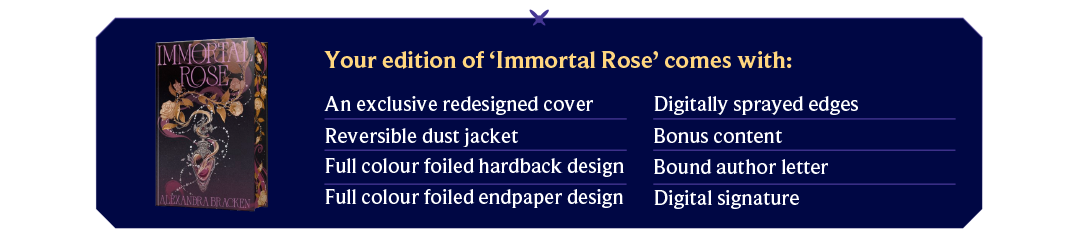
What is your favourite thing about the FairyLoot Exclusive Edition of Immortal Rose?
It’s hard to pick! I love the endpaper art so much, especially their faces and the way the foil is, it’s just stunning! And then the naked case is gorgeous. It such a beautiful edition, I’m thrilled with it and so grateful, and I hope everybody else loves it, too!
Blog Post Copied to Clipboard
Most Recent Stories

Follow Us
Most Recent Stories

Conversation
0 Comments