
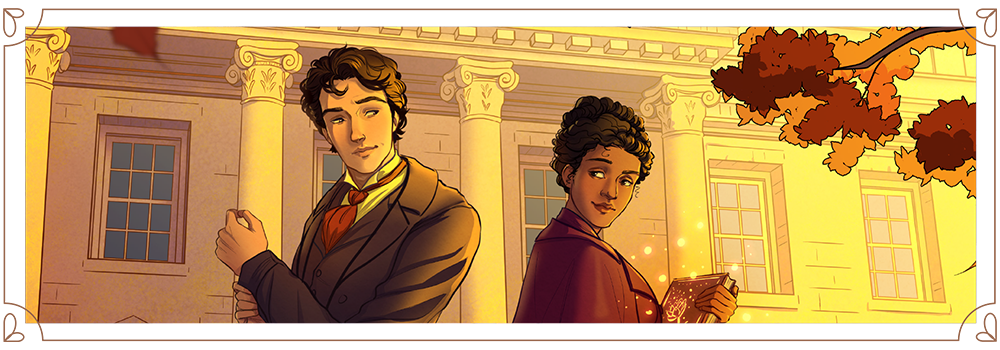

Get the inside scoop on ‘Hawk & Sparrow’!
Ayana Gray is the author of our September Young Adult ‘Society & Sorcery’ featured book: Hawk & Sparrow. Read on to get the inside scoop from inspiration to favourite scenes and more!
Can you tell us a little bit about your inspiration for Hawk & Sparrow, and how the idea initially came about?
Unfortunately, I’m not one of those authors that has a moment, a dream, or a single thing that inspires me. It tends to be sort of piecemealed. I had finished writing my adult debut which is called I, Medusa, and that book is very much a tragedy. It’s a very heavy book, and I had to go to a tough place emotionally to write it. So, I really wanted to do a palette cleanser and write something the total opposite of that; something whimsical and hopeful and happy! I also wanted to try my hand at writing a book that was very deliberately romantic, and a book that had a murder mystery, which proved to be very hard! Also, I think most importantly, I wanted to write a story that was just unapologetically autumnal. Everything about it is supposed to evoke all of the things I love about autumn specifically. So, all of those wishes came together, and that is how Hawk & Sparrow was born.
The novel has a fascinating Gilded Age-inspired setting. What drew you to this particular historical period, and what aspects did you most enjoy reimagining through fantasy?
I’m excited because the Gilded Age is having a moment, which I did not plan for! But it’s this era that often gets forgotten because for us in the United States, it was right after the Civil War but right before World War I, these two really big moments. But it was such an exciting era, because so much technology that we have today was invented then, and we had a lot of immigrants coming to America and shaping the country. It was also obviously defined by lots of glamour and wealth; it was named the Gilded Age because Mark Twain coined that term. With something that is gilded, it is covered in the facade of gold but is not necessarily made of gold. So, there was an appearance of luxury but beneath that, it was not always glamorous. I just found that really interesting! And some people say that we’re in a second Gilded Age right now. When people think of the Gilded Age they think of balls and parties and wealth, but I had a lot of fun digging into what was beneath that; people fighting for their rights, especially women!
Was there any particular research you had to do for this novel?
Oh, I did a lot! I, Medusa was set in ancient times of which there’s not much information on. But the Gilded Age, we have so much information because this is the 1890s, which isn’t that far in relativity. In the US it was the Gilded Age, but in the UK it was the Edwardian period, and a lot of the rich in the US looked to Europe for indicators on what they should be doing regarding fashion and trends. So last summer, I actually went to London and went to The King’s Gallery, and there was an exhibit about the Edwardian period so that’s where some of my research took place! My editor and I also did a walking tour with a Gilded Age historian in the Upper Eastside, New York City. I read a tonne of books and listened to a tonne of podcasts about the Vanderbilts and the Astors and all the big players. I had a lot of fun totally obsessing over all things late 1800s!
Basalton feels like a world where magic, wealth, and social status are closely intertwined. How did you approach building a society where magic itself becomes a marker of privilege?
I’ve written a story where magic was forbidden and hidden, and I think we see that trope in fantasy a lot, so I wanted to challenge myself to do something different. I asked myself, what if magic is not a secret? What if magic is very much a part of everyday life but is gate-kept so that only certain people have access to it? And specifically, people who can afford an education. Because as someone who lives on these intersections of privilege — I’m privileged in some ways and I’ve been marginalised in others— I think it is really fascinating to think about that, about how you can be part of the have’s in one area of your life, and one of the have-nots in another. And I studied political science when I was in university, so I’m naturally drawn to the conflict between those who have power and those who do not. Adding magic to that was really fun, because you have Vesper who is staunchly working class, does not have access to sorcery, and has very strong opinions about it. And then you have Maximilian, who is the exact opposite! He’s wealthy, he’s a sorcerer, and he has always had access to everything he wants. Then you force them to work together and force them to have a common goal, and that, to me, is really fun as a writer!
Journalism plays such an important role in the story. What interested you about exploring the world through the eyes of a young reporter rather than a traditional fantasy hero?
Well Vesper is a writer, and I’m a writer, so it is very easy to tap into certain things about her personality and her inquisitiveness. We take it for granted now that it wasn’t always safe to be a reporter, and it really still isn’t in certain parts of the world. But in the US even, in the west, it really wasn’t easy to be a reporter and speak on the truth. It definitely wasn’t easy as a woman in the 1800s! Vesper is partially inspired by Ida B. Wells, a real African American journalist and civil rights movement figure. Also, if you’ve watched The Gilded Age television show, you’ll know Peggy Scott who is also a writer. I think there’s a lot of power in powering your pen, and I wanted to do that to show you can be strong in that way, too.
Vesper is ambitious, determined, and understandably sceptical of the world around her. What was your favourite aspect of developing her character?
I really appreciated, maybe for my own cathartic reasons, Vesper’s feelings about romance. When I was a teenager, I had friends that would look at a guy and be like, oh my god I have a crush on him! And that would confuse me, because I was like, but you don’t know him! Vesper is that kind of person, where she can’t feel this instant love or instant attraction. She has to connect with them on a deeper level, and I’m glad I got to write a character like that. She and Max fall for each other because they respect each other. It’s not an instant thing, it’s a meaningful connection.
The rivals-to-lovers dynamic is a favourite among readers. What do you think makes this particular pairing interesting, and what did you want to bring to the trope?
People love tension! Whether you’re talking in film or books, tension is just fun, interesting, and intriguing. Max and Vesper are truly opposites, and not just socio-economically. Max is very loosey-goosey, he’s late to things and chaotic. Whereas Vesper is really rigid and by the rules. And when you force two people who are so different to work together, it’s naturally going to create that tension. And it’s funny! I had so much fun writing Max, he is just ridiculous. I’ve talked about how he’s very loosely inspired by Howl Pendragon from Howl’s Moving Castle — a flamboyant sorcerer who loves desserts, no less! I had so much fun with the banter, I enjoyed writing it so I hope readers enjoy reading it.
Their relationship involves a fake courtship. What do you find so appealing about the fake-dating trope, particularly when it allows characters to explore unexpected sides of themselves?
It’s one of my favourite tropes but it’s one that I don’t see as often in fantasy. I’m always looking for what I don’t see often, and what I can use that’s a little more unique. And courting was such a big deal in the 1890s, it was really serious! But I think what’s fun about it is that the readers kind of know how it’s going to go, but they still want to see it pay off. It’s two people that don’t like each other, who not only have to be with each other, but also have to pretend they love it! And convince other people! Along the way they think, oh, was he pretending? Was that part of the act or not? There’s this push and pull happening that adds to the tension. I just had a lot of fun!
Which character surprised you the most during the writing process? Did anyone develop in a direction you hadn’t originally anticipated?
This is a whodunnit mystery, and initially I had a very different idea of the culprit behind the scandal!
Did writing Hawk & Sparrow teach you anything about yourself as a writer?
I learned that murder mysteries are hard! Some genres like fantasy are so broad that you can do a lot of different things. But murder mysteries and romances are two genres where there are very clear expectations from readers about what needs to happen, when it needs to happen, and how it needs to happen. I had never come up against that before, and so I learned how to do it. I learned how to balance and pull from different genres as this is part romance, part fantasy, and part mystery. I’m not sure if I’ll attempt that many genres again, but I learned!
If you could spend an afternoon in Basalton, where would you go, and which character would you most want to spend it with?
The coffeehouse that Max and Vesper spend a lot of time in is called Guillermo’s, and I named it after my local café here in Arkansas where I live! So I would go to Guillermo’s and would get my order of a hot croissant with hot chocolate. And I think I would have equal fun with Vesper and Max, it would just depend on my mood. If I want to have a really deep, intellectual, cool conversation, I would go with Vesper. Actually, I would probably have hot chocolate with Vesper, and then go shopping with Max, because he would be really fun to go shopping with!
What do you hope readers take away from Hawk & Sparrow once they’ve turned the final page?
The thing I talk about across all my books is that you do not have to change who you are to be worthy of love. And people who really love you will love you as you are, unconditionally, without anything attached to that.
What’s your favourite thing about the FairyLoot edition of Hawk & Sparrow?
Oh gosh! I love so much about it! But I really love how truly an ode it is to fall. Everything about it screams fall! And if you look, there’s little motifs like the bee that becomes important later, so there’s hints of things. But the oranges and the rust reds and all the leaves! I really enjoy decorating my house for the fall, and have the leaves and the pumpkins and the things that feel like the season, and I love that this book is such a perfect homage to that!
Blog Post Copied to Clipboard
Most Recent Stories


Follow Us
Most Recent Stories
Conversation
0 Comments