

Get the inside scoop on ‘Dawn of the Firebird’!
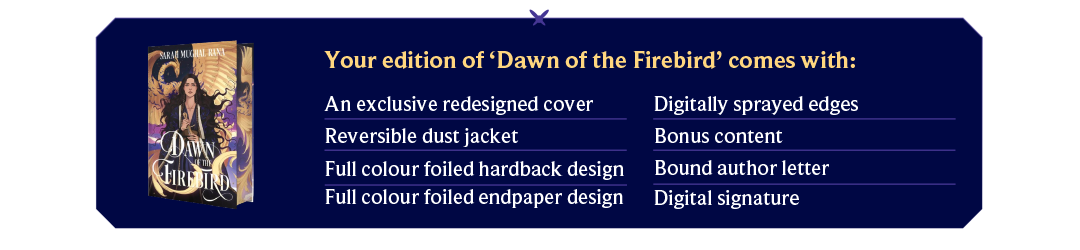
Sarah Mughal Rana is the author of our December Adult ‘Dagger & Dynasty’ featured book: Dawn of the Firebird. Read on to get the inside scoop from inspiration to favourite scenes and more!
What was the inspiration behind Dawn of the Firebird?
The inspiration was many things! But beginning with the characters, I grew up loving anime and manga such as Jujutsu Kiasan and Naruto, and I really wanted to see those types of stories in book form. I wanted to see someone who grew up going through this arc of coming into power. But, I did not want them to be a hero, and so that is where this idea began. In my book, you follow my main character, Khamilla, who see’s so much destruction — she’s seen warfare, she’s seen genocide, and she’s been taken away from her homeland. This book is about her taking agency, her picking up the sword and trying to reclaim what belongs to her. It’s not a typical story about a girl who wants the throne or power, she wants revenge.
Were there any myths, histories, or cultural touchstones that subtly shaped the story’s foundation?
That’s complicated, as this is not a book that I would box into cultural hallmarkers. However, if you have an abrahamic religion or you’re familiar with the Christian, Jewish, or Muslim religions, this book will have so many Easter eggs! The book takes place after Noah’s flood which is such a famous story, but the one thing I always tell readers is that it does not matter what background you come from or what religion. If you look at recorded history and the history of humanity, every single culture has a flood story. And so I took the idea of a flood story, this big wave that takes out people, as inspiration, and was of course informed by Islam and how we interpret flood stories. I was also inspired by firebirds! And in Islamic traditions, if you look at Persian poetry or other parts of Asia such as Pakistan and Iran, they have a story of a Simurgh, which is a type of phoenix, but it’s not the traditional firebird with flames. So that is what I was inspired by and you learn about it in the book!
Speaking of firebirds, we love the title of this book as it’s so striking and intriguing! Can you tell us a little bit about what “the firebird” symbolises?
So I have loved getting DM’d and tagged in reviews where people have dissected how Khamilla is like a firebird. She is someone who gets trodden on over and over again until she rises again. And because of this you see different forms of her — she is someone who goes through so much trauma that she literally forgets it happened and almost becomes a new person. You see her as someone who is innocent and young, someone who is fiercely loyal to her clan, and then you see how every part of her kind of dies and then someone else gets reborn. And so this story, Dawn of the Firebird, is of someone who goes through multiple resurrections in a sense, and then she rises from the ashes. It’s so exciting to see her on that journey.
What qualities were most important for you to capture in your main protagonist, Khamilla?
Firstly, I wanted someone who was almost hollow. Someone who was a blank canvas that anyone could paint any which way. That was important because although she’s an adult, you still see many coming of ages in her where she adapts to the environment. And so I wanted her very hollow, as it makes it more satisfying as a writer to see her go from the most inhuman, cold person, to someone who becomes human. Secondly, I wanted someone who was not a typical bad*** protagonist. She knows how to fight, you actually see her train and dual and beat really strong people. But also, she’s someone who is so vulnerable and flawed, someone who is so deeply stuck in her principles that it is satisfying to see her get challenged and then see her overcome her previous ideologies and prejudices. So I wanted to see someone who really embodied an arc, instead of someone that was perfect from the beginning. It’s fun to read someone who makes mistakes first!
Can you tell us a little bit about how your characters challenge or complicate one another, rather than simply supporting the plot?
I’ll begin with the children as I think they are who the readers get most attached to. They’re like the loser squad, the nobodies, and so everyone underestimates them. And I always love writing an underdog and watching them come to strength! But Khamilla is tasked with training them, and they challenge her because they’re innocent kids. They don’t know the horrors of war the same way she does, and so they challenge her view because Khamilla has a revenge arc. Now, she has to contend which a bunch of innocent children as she doesn’t want to harm them in her revenge. And then there’s her brother and her aunt who are two people I would put as her moral pedigree. They’re people who are almost untouched by the all the moral greyness and darkness of the world. No matter what they’ve gone through, they’ve always shone as this ironic lightness. And no matter how far Khamilla falls in her revenge and anger and grief, these are two people that will always pull her back out. They challenge her world view because they challenge her resilience.
What came first for you: the world itself or the characters inhabiting it?
Definitely the characters! Almost every character I conceived in the first draft exist in the book, I’ve just had to add a bit more and flesh them out to be living, breathing characters.
How did you approach building a setting that feels immersive without overwhelming the reader?
In the early drafts, I had a word doc where I put all my research and all my world building in, and it’s hundreds of pages. My magic system, my glossary, all of it! And it really made the world feel like a character. N. K. Jemisin, one of the most prolific fantasy writers of our generation, has always said to treat the world like a character, so that’s what helped.
Are there particular themes you hoped readers would feel rather than consciously identify?
I think the main theme that I really wanted to get across to readers was that no world exists in the form that you believe it to be. And what I mean by that is everything you believe, everything you see in your country, even your identity, your ethnicity, the way that you believe in different social, religious, or idealogical systems, those are things that were enforced and put down on you. And it’s up to you to challenge those world views. Do your research, look at what you’re fed through news, through people, through conversation, and expand it. Let yourself feel and immerse yourself in a diverse chamber of opinions and conversations and discourse. If we’re stuck in our own echo chambers of beliefs, we dehumanise the person that doesn’t agree with us. But as soon as you open yourself up, you will start seeing people as human beings and that’s where love, peace, and these ideas come from. It’s not that it’s perfect – no one is and none of these ideas are. But, you have to be able to see someone as a human being to engage with them as an equal.
Did your writing process change over the course of the book, especially as the story’s scope became clearer?
Of course! So when I started writing it I was so young, and when I finished the first draft I was only eighteen. I remember I was on a plane to Japan, I skipped prom, and I decided to go on a graduation trip with my best friend instead. And on the plane I was secretly writing so she wouldn’t see! So I was insecure, I was hiding that I was a writer, and I didn’t feel like I was fit to do it. And then when I got to undergrad in college, I was able to go to coffee shops and was able to find that private time to write. But even then I still felt almost ashamed, like I had to hide it and like I had to choose. And it wasn’t until the last year when my book came out that I realised that two parts of me can exist. I can still be the girl whose an academic who works in tech, but the creative part of me can still exist. Right after I finish my 9-5 I can go to a coffee shop and write. So that routine, really unapologetically taking time out to be like okay, this is still work. I need to dedicate time to write, and then communicating that to friends and family has really helped me write faster. It has helped me feel like its a job, not just a hobby I have to hide. I’m definitely in a happier and healthier place with it.
What did you learn about yourself as a writer while working on this book?
I’m a very anxious person, and although I love seeing what readers are tagging me in and seeing the joy, I think I’ve learned that protecting your own space and how you interact with characters as a writer is so important for creative integrity. You know, making sure that I don’t get influenced on how I write my book, how I do the work. I have people who read it for feedback and obviously I have my editors, so I really want to protect that creative relationship. I also think I’ve realised that I’m not someone who can write a messy draft. I’m not someone who has a scene in my head and can work on the middle of the book and then jump back to the beginning. I am so ADHD that I need to get all my thoughts and all my scenes that I want in the book out in the first draft. So that was something that sucked when I realised it, but at least I know I’m doing all the heavy work right now and then in the second, third draft, I won’t be working from scratch.
Is there anything you can tell us about the sequel?
Yes, I am very bad a secrets! My editor was like, okay, you can say the title because you’ve already spoiled it all over your stories! This series will be a trilogy, but the sequel to Dawn of the Firebird is called Fall of the Heavenly Crane. It’s my favourite title out of all the titles for the three books. I also think it’s my favourite symbolically because I love cranes the most out of all the birds in the book, and I think it symbolises my main character the most. Also I know there was a cliffhanger in book one, so don’t worry — we wrap that right up in book two! I’ve also been able to explore the romance a lot more and I’m having so much fun doing it! It all gets very unhinged in book two and I’m very excited!
What’s your favourite thing about the FairyLoot edition of Dawn of the Firebird?
I think it is definitely the endpapers! I’ve never seen endpapers that have captured this — I’ve never seen endpapers that made me be like, that is exactly what I envisioned! This was just like the mountain pass that I was riding horses on when I was writing the book in the Himalayas. I don’t know how Mona, the artist, captured it so well! It just got the heart of the book. And of course, we can’t forget the naked hardcover!
Blog Post Copied to Clipboard
Most Recent Stories


Follow Us
Most Recent Stories

Conversation
0 Comments